Bimota Tesi
The Bimota Tesi (translated: "Thesis") is a motorcycle model in the superbike class, produced by the Bimota company of Italy.
≈ 3 min read
Bimota Tesi. encyclopegia.org, snapshot enwiki-001360485018. /a/bimota-tesi
Names in other languages
No names in other languages are held for this entry yet.
Article bodies are English and are not machine-translated. A name in another language is not a translation of the article.
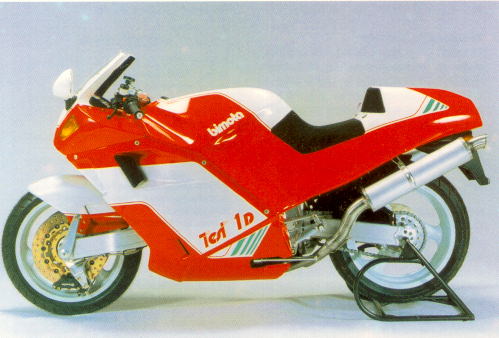
The Bimota Tesi (translated: "Thesis") is a motorcycle model in the superbike class, produced by the Bimota company of Italy. It is distinctive for its front wheel being mounted via a swinging arm arrangement with hub-center steering, unlike the telescopic forks more common in modern motorcycles.
Summary
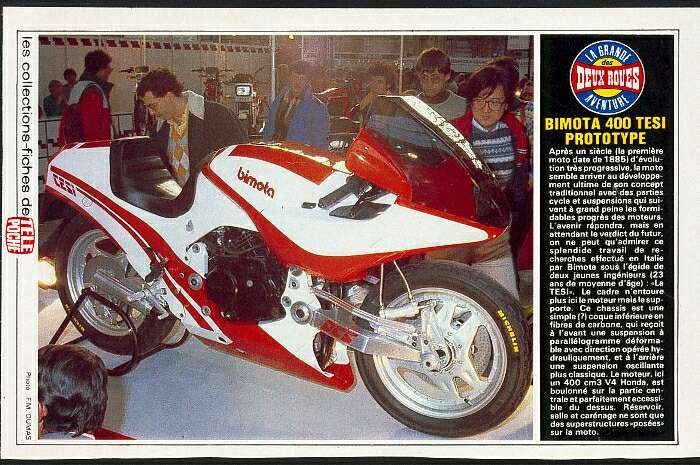
While the prototype Bimota Tesi was unveiled in 1983, it was not until 1990 that a road-legal version was commercialized—the Tesi 1/D. The lineage was discontinued in 1994. The model line resurfaced in 2002 with the Tesi 2/D, developed by an Italian tuner who marketed it under his name (Vyrus 984 C³ 4V). This was followed in 2007 by the Tesi 3/D, ensuring the model's continued existence.
The main innovation of the Bimota Tesi is its use of a swingarm and hub-center steering system instead of a conventional telescopic fork. This design is intended to eliminate the "dive" effect of traditional forks under braking and to provide improved stability. Many Tesi models have been powered by engines from different manufacturers.
The early prototypes were equipped with Honda and Yamaha engines, but Ducati was ultimately chosen for the final prototype and all production models up until 2015. Kawasaki later took over, supplying the engine for the Tesi H2. The Tesi was also fitted with the 500 V-Due engine.
Unlike Bimota’s usual naming convention—where the first letter represents the engine manufacturer, the second stands for Bimota, and the number indicates the model’s order of release—the Tesi series follows a different pattern. The initial research leading to the Tesi began when engineering student Pierluigi Marconi, for his university thesis at the University of Bologna, drew inspiration from engineer Difazio's work to develop a motorcycle where the steering and front suspension would be independent.
He named the resulting bike Tesi, meaning 'Thesis' in Italian. The letter D stands for the engine manufacturer, and the number represents the model's generation. The first Tesi developed after Kawasaki's investment in Bimota was called the Tesi H2, as it inherited the Kawasaki Ninja H2 engine.
Engine
An initial model was powered by a Yamaha FZ750 engine; subsequently Honda V-4 and then Ducati V-Twin motors were adopted; in the wake of the takeover of Bimota by Kawasaki in 2019, since 2020 they have used motors by Kawasaki.
Models
Bimota produced the first Tesi in 1984. As of 2017, 18 generations of Tesi had been produced. Subsequent models have included the Ducati-powered Tesi 1D, Tesi 2D, Tesi 3D and the Bimota Tesi H2 (2020).
Tesi H2 model overview
Bimota Tesi H2 models have included five variants, one for each year from 2020 to 2024, with (according to one source) the early ones having 300 hp and subsequent ones 228 hp; they have been available in increasingly varied colour lines.
Text derived from https://en.wikipedia.org/w/index.php?oldid=1360485018 under CC BY-SA 4.0; modifications have been made.