Cross-platform interchange
≈ 24 min read
Names in other languages
No names in other languages are held for this entry yet.
Article bodies are English and are not machine-translated. A name in another language is not a translation of the article.
A cross-platform interchange is a type of interchange between different lines at a metro (or other railway) station. The term originates with the London Underground; such layouts exist in other networks but are not commonly so named. In the United States and Canada , it is often referred to as a cross-platform transfer. This configuration occurs at a station with island platforms, with a single platform in between the tracks allocated to two directions of travel, or two side platforms between the tracks, connected by level corridors. The benefit of this design is that passengers do not need to use stairs to another platform level for transfer. A cross-platform interchange arrangement may be costly to build due to the complexity of rail alignment, especially if the railway designers also arrange the track with flyovers (which is typically done to increase efficiency). A typical bidirectional cross-platform interchange configuration consists of two outbound directions of two different lines sharing an island platform, and the respective return directions of both lines sharing a different island platform in the same station complex.…
A cross-platform interchange is a type of interchange between different lines at a metro (or other railway) station. The term originates with the London Underground; such layouts exist in other networks but are not commonly so named. In the United States and Canada , it is often referred to as a cross-platform transfer. This configuration occurs at a station with island platforms, with a single platform in between the tracks allocated to two directions of travel, or two side platforms between the tracks, connected by level corridors. The benefit of this design is that passengers do not need to use stairs to another platform level for transfer. A cross-platform interchange arrangement may be costly to build due to the complexity of rail alignment, especially if the railway designers also arrange the track with flyovers (which is typically done to increase efficiency). A typical bidirectional cross-platform interchange configuration consists of two outbound directions of two different lines sharing an island platform, and the respective return directions of both lines sharing a different island platform in the same station complex. Less common is a cross-platform interchange to transfer onto a continuation of same single line served by that station; examples of such interchanges include and in the United Kingdom, Pittsburg/Bay Point on the BART in California, and Estadio Metropolitano, Puerta de Arganda and Tres Olivos on the Madrid Metro.
Types
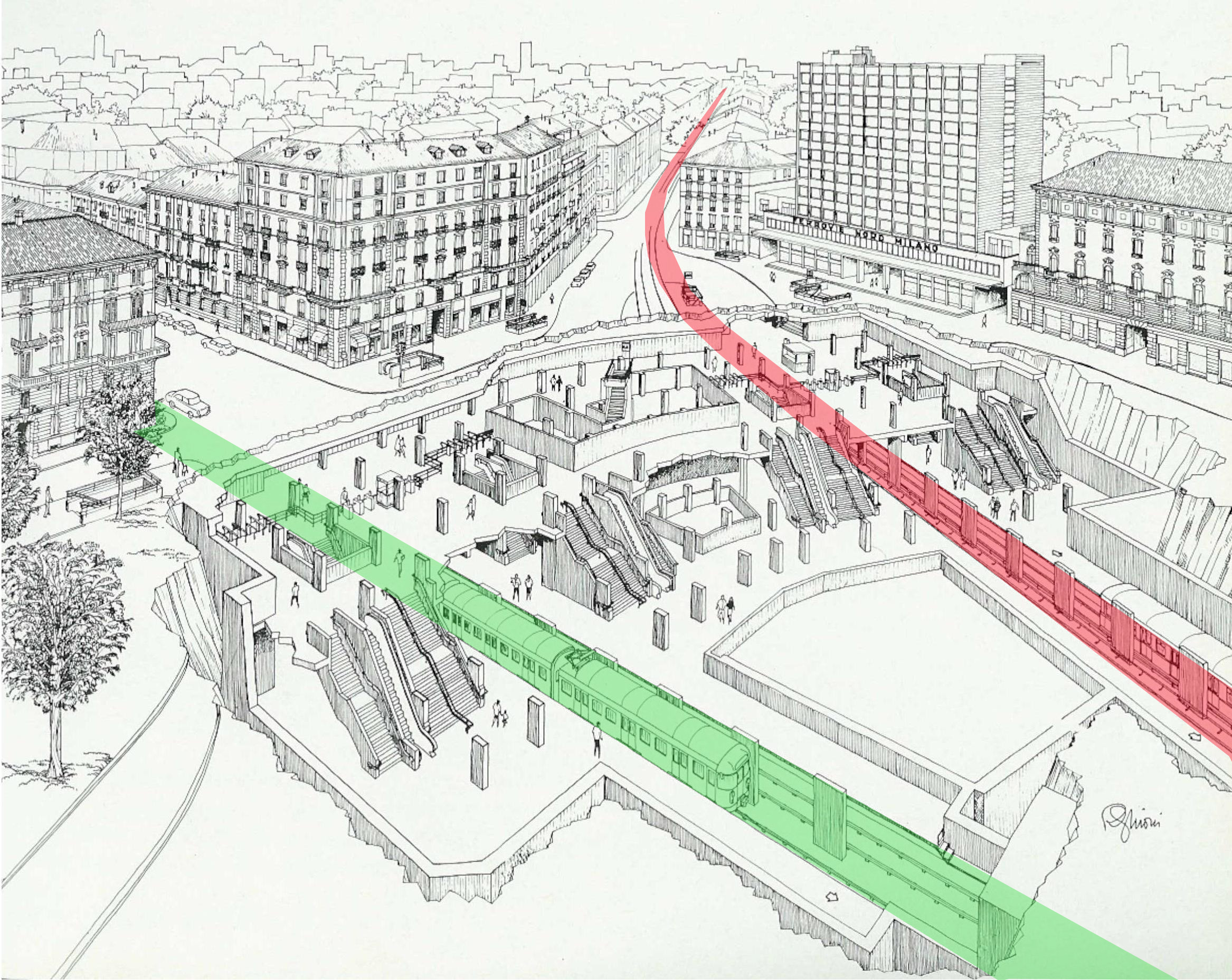
, showing the tripartite-interchange system on the right
Between different lines
Common cross-platform interchanges allow passengers to change trains without changing to another platform. This applies at places where trains of different directions meet in minor and major hubs, but this arrangement is only found at some interchange stations in metro and other rail networks worldwide.
Between different train categories of the same line
Some railway lines, usually in more congested areas, also offer cross-platform interchanges between different categories of trains, for example between express and stopping ("local") trains. For instance, this kind of interchange is used at many European railway minor hubs to connect fast trains to local feeder services, as well as surface sections of suburban lines like the RER E in Paris or the Metro North Hudson Line in New York State. However, local–express interchanges are found in only a few metro networks, such as Chicago, Chengdu, London (as in the case of Stratford discussed below), New York City, and Philadelphia. The New York City Subway system has numerous stations facilitating cross-platform transfers between local and express trains, typically using pairs of island platforms, each serving express trains on one side, and local trains on the other side, with both alternatives headed in the same direction. As express and stopping trains usually head for different directions, cross-platform interchange between different train categories (e.g. interchanges between metros and railways) is commonly combined with cross-platform interchanges between different lines. Some stations offer cross-platform transfers between different modes, such as tram and bus, such as at Madeleine station in Charleroi, where two island platforms sit between a central bus lane and tram line on the outside. Similarly, light rail–bus connections can be found at Juniors Kingsford and Haymarket light rail stations in Sydney.
Continuation of travel in different trains
Ormskirk railway station in Lancashire, United Kingdom, was a double-track railway until 1970, when it was converted into single-track railway with the track split in the centre by buffer stops placed back-to-back. The two ends of the single platform terminate different routes, and interchange for through service is by walking along the platform. Another peculiar configuration exists at Pittsburg/Bay Point station on the BART system in the San Francisco Bay area, California, United States. Mainline BART trains terminate at that station, but onward service is available via an eBART diesel multiple unit (DMU) train. At this station, eBART trains are only accessible through a cross-platform transfer at a dedicated platform east of the main station platform. Despite this transfer, the Yellow Line is mapped and signed as one continuous route. of Nanjing Metro, China, providing continuation of travel between Line S1 and S7. Konggangxinchengjiangning station of Nanjing Metro, China is also a cross-platform terminal station for both Line S1 and S7, with a single island platform and crossovers set at both ends of station, letting trains of both lines to switch back. Zhongli railway station in Taoyuan, Taiwan has a proposed cross-platform terminal plan for both Taoyuan Airport MRT and Green line of Taoyuan Metro. The station layout will be composed of two island platform, between which a connecting zone set to integrated the two into a single "large platform". Buffer stops will also be placed back-to back between Airport-bound trains and Green Line trains. The scheme is scheduled to complete in 2031.
Service levels of connections
In some, but not all, cases, the trains are coordinated in the timetable.
Noncoordinated
In this case, the cross-platform infrastructure offers the possibility of easily changing trains, independently from the waiting time for the second train. In metro systems with short headways, typical waiting time is small, but such a noncoordinated approach could reduce the advantages of stairless cross-platform interchange in railway networks with sparser train traffic.
Coordinated
A more-advanced approach involves the coordination of the lines' timetables to reduce the scheduled changing time, either from one line to the other, or ideally bidirectionally, between both trains simultaneously. Coordinated interchange is widely used in Dutch, German, and Swiss railway networks, where trains of different lines meet at the same platforms in numerous hubs all over the country.
Optimised, with connection guarantee
Most advanced are coordinated cross-platform interchanges wherein interconnected trains also wait for each other, to "guarantee" scheduled interchanges even in the event of modest delays. To limit schedule disruption propagation throughout the entire network, additional waiting time for trains is usually limited to a certain period of time, depending on general network performance, further connections to be guaranteed, train category, train line, and a balanced consideration of other factors. In practice, most railways coordinating cross-platform interchanges define a certain waiting time window for each guaranteed interchange. Some railway operators will briefly delay train departure signals to allow imminently arriving passengers time to interchange. For example, the Vienna U-Bahn metro signals train drivers to wait briefly, by operating a special white light signal triggered by the approach of an interchange train on another track.
Example interchanges
In most cases, only cross-platform interchanges used for both directions of travel are listed, with some exceptions.
Asia
Beijing
Cross-platform interchanges are offered between Line 9 and Fangshan Line at , Lines 4 and 9 at , Changping Line and Line 8 at , Lines 7 and 9 at Beijing West railway station, and Fangshan Line and Yanfang Line at . In addition, cross-platform interchange is possible at between Line 6 and 8 via level corridors. The Line 5 alighting platform and Yizhuang Line boarding platform at connect perpendicularly in a T-shape, allowing single-direction cross-platform interchange from Line 5 to Yizhuang Line.
Chengdu
, Chengdu. The double track of Line 2 of Chengdu Metro is in the middle, while the double tracks of national rail transport system (Chengdu–Dujiangyan intercity railway) are on both sides. Xipu Station in Chengdu provides cross-platform interchange between Line 2 of Chengdu Metro and Chengdu–Dujiangyan Intercity Railway of the national rail transport system. It is the first implementation of cross-platform interchanges between different train categories in China. Metro-only cross-platform interchanges exist between Lines 2 and 4 at Chengdu University of TCM & Sichuan Provincial People's Hospital station, between Lines 5 and 6 at Xibeiqiao station, between Lines 17 and 19 at Jiujiang North station, between Lines 18 and S3 at Futian station and outbound direction interchanges between Lines 3 and 10 at Taipingyuan station.
Chongqing
Line 5 and Line 6 of the Chongqing Rail Transit offer a paired cross-platform interchange for passengers transferring among four directions between the two lines at Ranjiaba and Dalongshan stations. Same-direction cross-platform interchanges are also provided at Chongqing West Station between Line 5 and Loop line, Baoshuigang between Line 4 and Line 9, Shangwanlu between Line 10 and Line 9 and Wangjiazhuang between Line 6 (International Expo Branch) and Line 10. Meanwhile, an opposite-direction cross-platform interchange is provided at Jiangbeicheng between Line 6 and Line 9. Aside from these, Min'an Ave. between Loop line and Line 4 is an exception. Due to the fact that Line 4 only uses one side of the platforms at this station, there formed a half cross-platform interchange.
Dalian
The Dalian Metro has a cross platform interchange between Line 1 and Line 12 at Hekou Station.
Delhi
The Delhi Metro has 4 cross-platform interchanges in total. These are located at the following stations:- Central Secretariat: Underground interchange between the Yellow Line and Violet Line Yamuna Bank: At-grade interchange between Line 3 (Main line) and Line 4 (Branch line) of the Blue Line Anand Vihar: Elevated interchange between Line 4 (Branch line) of the Blue Line and Pink Line Botanical Garden: Elevated interchange between Line 3 (Main line) of the Blue Line and Magenta Line
Guangzhou
Guangzhou Metro offers three two way cross-platform interchanges by 2016, between Line 2 and Line 3 at Jiahewanggang station, between Line 8 and the Guangfo Line at Shayuan station, between Line 22 and 18 at Panyu Square station, between Line 14 and 21 at Zhenlong station, between Line 11 and 21 at Tianhe Park station, one between both branches of Line 3 at Tiyu Xilu station and between Line 11 and 12 at Chisha Station. At Tiyu Xilu station the northern section of Line 3 terminates at the center track serving both island platforms connecting to the southern section of Line 3 stopping at the outer tracks. In 2016, a same-direction cross platform interchange started operating between the westbound Line 7 and northbound Line 2 trains at Guangzhou South Railway Station. Several cross platform interchanges are under construction. These include: Guangzhou Baiyun Railway Station (Line 12 and 24) and Caihongqiao station (Line 13 and 11).
Hangzhou
Hangzhou Metro's East Railway Station and Pengbu station offer paired cross-platform interchange between Line 1 and Line 4 and another paired cross-platform interchange at West Lake Cultural Square and Wulin Square stations between Line 1 and Line 3. Same-direction cross-platform interchange is offered between Line 2 and Line 4 at Qianjiang Road station, Coach Center between Line 1 and Line 9, Zhejiang Chinese Medical University station between Lines 4 and Line 6, Xintiandi Street station between Line 3 and Line 4, Guanyintang station between Line 7 and Line 9, South Xixi Wetland station between Line 3 main line and branch line (Line 14 future), Lvting Road station between Line 3 and Line 16 and West Railway Station between Line 3 and Line 19.
Hong Kong
and the Kwun Tong line In the Mass Transit Railway (MTR) system, cross-platform interchange stations first appeared at Mong Kok and Prince Edward stations in Kowloon when Tsuen Wan line was opened and took over the southern half of the Modified Initial System. The interchange is two platforms in sequence, with an opposite-direction cross-platform interchange assigned to Prince Edward and a same-direction interchange to Mong Kok, as large volumes of traffic had been anticipated in both modes. Popular with passengers, this design was repeated on Admiralty station when the Island line in Victoria was opened to deal with anticipated heavy opposite-direction interchange ridership. Years later, another interchange spanning Tiu Keng Leng station (same direction) in the New Territories and Yau Tong station (opposite direction) in New Kowloon was built to the same configuration as the earlier Mong Kok and Prince Edward interchanges. cross-platform interchange The Tuen Ma line is specifically designed to follow right-hand traffic rules (unlike other railway lines in Hong Kong), to enable a same-direction cross-platform interchange at Tai Wai station to the East Rail line while keeping the two southbound platforms connected via ramps. Another configuration found in Lai King station makes commuting in both directions more convenient by aligning both tracks leading towards the city next to each other on one level, and both tracks leading away from city next to each other on another level. The configuration for North Point station is similar, to provide convenience for passengers traveling inbound, although the distance between the two platforms is longer compared to other stations. Before the MTR–KCR merger in 2007, Nam Cheong station was served by MTR's Tung Chung line and KCR's then-called West Rail line. Due to the different fare systems, platforms of southbound Tung Chung Line and northbound West Rail were separated by barriers despite being at the same elevation, and interconnecting passageways were regulated with one instead of two sets of ticketing barriers. After the merger, some sections of the barrier were demolished in order to provide free cross-platform interchange between southbound Tung Chung Line and northbound Tuen Ma Line trains. However, this arrangement does not serve the dominant rush hour passenger flows, which are between New Territories and Hong Kong Island, as well as between Lantau Island and Tsim Sha Tsui. To connect East Rail and the then called West Rail Line at Hung Hom without through-running, both lines were in the past terminated in the south there, alternating on both East/West Rail platforms to offer cross-platform interchanges. But after the station relocation in 2022, Hung Hom is no longer a cross platform interchange. At Sunny Bay, passengers on the Tung Chung line from the city can make a cross-platform interchange to a train. However, the inverse is not the case, so passengers returning to the city from Hong Kong Disneyland need to use an overpass to catch a Hong Kong-bound train.
Kuala Lumpur
and Kelana Jaya Line. offers cross-platform interchange between Sri Petaling Line (Line 4) and Kelana Jaya Line (Line 5) while offers cross-platform interchange between Ampang Line (Line 3) and Sri Petaling Line (Line 4). Tun Razak Exchange and Kwasa Damansara also offers cross-platform interchange between MRT Kajang Line and the MRT Putrajaya Line.
Kyoto
There is a cross-platform interchange between the Kyoto Municipal Subway Tozai Line and the Keihan Keishin Line at .
Nanjing
Nanjing Metro's Nanjing South Railway Station offers cross-platform interchange between Lines 1 and 3 and same-direction cross-platform interchange between Line S1 and Line S3. In addition, a cross platform interchange is available at Xiangyulunan Station between Line S1 and Line S9, and Konggangxinchengjiangning Station between Line S1 and Line S7.
Nanning
A paired cross platform interchange is available between Line 1 and Line 2 at Nanning railway station and Chaoyang Square station. This configuration allows for North & East-bound and South & West-bound cross platform transfers at Nanning railway station, while Chaoyang Square station allows for North & West-bound and South & East-bound cross platform transfers.
Osaka
The Osaka Metro has a cross-platform interchange between the Midosuji Line and the Yotsubashi Line at Daikokuchō, where the platforms are at the same level. Kintetsu Railway also has a cross-platform interchange between the Nara Line and the Osaka Line at Tsuruhashi, where the platforms are at the same level. Hanshin Railway has a same direction cross-platform interchange between the Namba Line and Hanshin Main Line at Amagasaki. Hankyū Railway has coordinated cross-platform interchanges between their Kōbe Line, Takarazuka Line, and Kyōto Line at Jūsō; and between its Kyōto Line and Senri Line at Awaji. They also offer coordinated cross-platform interchanges between express and local services on the same lines at many stations, such as at Katsura on the Kyōto Line; and at Nishinomiya-Kitaguchi on the Kōbe Line.
Qingdao
Cross-platform interchange is available between Line 2 and Line 3 at . Provisions for cross-platform interchange between Line 3 and Line 8 were made at Qingdao North Railway Station.
Seoul
Seoul Subway Geumjeong Station offers cross-platform transfer between Line 1 local services and all 4 services. Gimpo Airport Station also offers cross-platform transfer between all Line 9 services and AREX local service. Also several Line 1 stations offer cross-platform transfer between trains heading to Incheon or Cheonan/Sinchang.
Shanghai
Oriental Sports Center Station offers cross-platform interchange between Lines 6 and 11. In addition, Hongqiao Railway Station provides cross platform interchange between Lines 2 and 17. While Hongqiao Airport Terminal 2 Station provides a same-direction cross-platform interchange between the Line 2 Pudong International Airport bound trains and Line 10 Xinjiangwancheng bound trains. Shanghai Railway Station and Zhongshan Park also offer cross-platform interchanges between Outer Loop Line 4 trains and Shanghai South Railway Station bound Line 3 trains and Inner Loop Line 4 trains and North Jiangyang Road bound Line 3 trains, as the two lines share a portion of the same track.
Shenzhen
Shenzhen metro network includes cross-platform interchanges at Laojie (Lines 1 and 3), Huangbeiling (Lines 2 and 5), Chegongmiao (Lines 7 and 9), Hongshuwan South (Lines 9 and 11), Nanyou (Lines 9 and 12), Huangmugang (Lines 7 and 14), Gangxia North (Lines 11 and 14), and Universiade (Lines 14 and 16) stations. Reservations have been made for future cross platform interchanges at (Lines 14 and 17), Xiangmihu West (Lines 14 and 20), Xinsheng (Lines 3 and 21), and Aobei (Lines 14 and 21) stations.
Singapore
in Singapore The Mass Rapid Transit system in Singapore has a similar two-station transfer arrangement to allow quick transfers between North–South and East–West lines. Both City Hall MRT station and Raffles Place MRT station have double underground island platforms stacked on top the other, allowing commuters to switch trains to a different line by walking across the same platform at the appropriate station. Jurong East MRT station has a less complicated arrangement, with the terminating rail for the North–South Line aligned between that of the East–West Line, allowing commuters to alight and board simultaneously on either side, with an additional rail for the North–South Line used during peak hours. Tanah Merah MRT station also has a similar arrangement, with the terminating rail for the East West line Changi Airport Extension aligned between the two the East West line platforms, allowing commuters to alight and board simultaneously on either side too. The Bayfront MRT station is also a cross-platform interchange with double underground island platforms between the Marina Bay branch of the Circle Line and Downtown Line. The original plans for Promenade MRT station contained a similar arrangement but the existing Circle Line tracks to and from Dhoby Ghaut need to be crossed at the same levels by Downtown Line trains. Thus, Bayfront MRT station is the only station on the MRT system which offers cross-platform interchange between two different operators' MRT lines (SBS Transit operates the Downtown Line whilst SMRT operates the Circle Line).
Tehran
Sadeghieh metro station of Tehran metro offers cross-platform interchanges between both terminating metro lines 2 and 5; while suburban line 5 uses the outer tail tracks of each platform, metro line 2 uses one platform for alighting and the other for boarding. Line 2 uses platforms 2 and 3, and Line 5 uses platforms 1 and 4. Eram-e Sabz metro station also has a cross-platform interchange. It has a cross platform interchange between Lines 4 and 5. Line 4 uses platforms 1 and 4, and Line 5 uses platforms 2 and 3.
Taipei
, a main interchange station of Taipei Metro, provides cross-platform interchange between the Songshan–Xindian line (Green Line) and Zhonghe–Xinlu line (Orange Line) in Taipei, Taiwan. The Taipei Metro has four stations for cross-platform interchanges: (between the Songshan–Xindian line and Tamsui–Xinyi line), (between the Songshan–Xindian line and Bannan line), (between the Songshan–Xindian line and the Zhonghe–Xinlu line) and (between Zhonghe–Xinlu line and the Tamsui–Xinyi line). All these stations have two island platforms on different floors, most of them are same-direction cross-platform configuration except Dongmen Station which has an inverse cross-platform. Beitou Station allows for cross-platform transfers for southbound trains only due to differing operating routes.
Tokyo
In the Tokyo Metro, Akasaka-mitsuke Station provides cross-platform transfer between Ginza Line and Marunouchi Line. At Omotesandō Station, transfer between Ginza Line and Hanzōmon Line can be done on its two island platforms at the same level. Shirokane-takanawa Station uses the same way to offer cross-platform interchange between Namboku Line and Mita Line. At Kudanshita Station, cross-platform interchange is possible between a Shinjuku bound Shinjuku Line train and an Oshiage bound Hanzōmon Line train. In Shinjuku Station, transfers between JR East's Yamanote Line and Chūō–Sōbu Line use directional cross-platform interchange on two parallel island platforms. Between and , there are cross-platform interchanges between the Yamanote Line and the Keihin-Tohoku Line. At Ochanomizu Station, there is a cross-platform interchange between the Chūō–Sōbu Line and the Chūō Rapid Line. In the Tokyu Railway network at Ōokayama Station, cross platform interchange is provided between the Meguro Line and the Ōimachi Line. In addition Naka-Meguro Station provides cross platform interchange is available between the Tōkyū Tōyoko Line and Tokyo Metro Hibiya Line, and Futako-Tamagawa Station provides a cross platform interchange between the Tōkyū Den-en-toshi Line and Tōkyū Ōimachi Line.
Wuhan
Line 2 and Line 4 of Wuhan Metro's Hongshan Square station and Zhongnan Road station offer paired cross-platform interchange for passengers transferring among four directions of the two lines. Two more cross platform interchanges opened in Wuhan at Zhongjiacun station between Line 4 and Line 6, and Hongtu Boulevard station between Line 2 and Line 3.
Zhengzhou
A number of cross platform interchanges are reserved across the system with Shibalihe station reserving same direction cross-platform interchange between Line 2 and Line 9 (Chengjiao line), Zhengzhou East Railway Station reserves same direction cross-platform interchange between Line 5 and Line 8, Zhangjiacun station reserves same direction cross-platform interchange between Line 4 and Line 7 and Yaozhuang station reserves same direction cross-platform interchange between Line 4 and Line 16.
Europe
Amsterdam
Amsterdam metro network includes cross-platform interchanges at Van der Madeweg station between metro lines 50 and 53 and at Amsterdam South station between metro lines 50 and 52. Further, cross-platform connections are offered at Amstel station between metro lines 51, 53, 54 and suburban and intercity services of Netherlands Railways.
Barcelona
The Barcelona Metro has a cross-platform transfer between L2 and L3 at Paral·lel station.
Berlin
The Berlin suburban rail network includes cross-platform transfers at Berlin East and at Baumschulenweg / Schöneweide, Bornholmer Straße, Gesundbrunnen, Treptower Park and Wannsee suburban railway stations. Berlin metro services offer cross-platform connections at Mehringdamm (metro lines U6/U7), Nollendorfplatz (metro line U4 with outbound lines U1/U3) and Wittenbergplatz (metro lines U2/U3, outbound also U1) metro stations. Additionally, Wuhletal station offers cross-platform interchanges between lines S5 of Berlin suburban rail and U5 of Berlin metro. Jungfernheide metro station was built for cross-platform interchanges between line U7 and an extended line U5 towards Tegel Airport; the extension plan was abandoned following the decision to replace Tegel Airport with Berlin Brandenburg Airport. A part of one of the U5 tunnels is used by Berlin firefighters for fire and rescue training in a metro tunnel with an original train taken out-of-service. Similar provisions were also made at Schloßstraße metro station for cross-platform interchanges between line U9 and a never realised line U10.
Bochum
In Bochum's light rail and tram network (operated by Bogestra), a cross-platform interchange is offered at Bochum Hauptbahnhof (Bochum Main Railway Station) between light rail line U35 and sub-surface tram lines 302 and 310 on the lower level of the underground light rail station complex. U35 and 302/310 services to the south and southeast, and to the north and north-east stop at the same platforms.
Brussels
Brussels South railway station offers an interesting example of double-level cross-platform interchange, where the goal is to make it easier for passengers to "double back". The metro and premetro lines interweave so that, for example, one can arrive on the metro 2 or 6 from the north-east, walk across the island platform, and catch a tram 3 or 4 going south-east. Passengers making this journey in the opposite direction use the level below. Similar cross-platform interchanges offers Beekkant station between metro lines 1/5 and 2/6; in this area, lines 1/5 run on the right while lines 2/6 run on the left due to historical layout when formerly line 1B between Herrmann Debroux and Roi Baudoin stations branched off line 1B (running between Stockel and Erasme stations) and line 1A needed to change driving direction at Beekkant station. At Brussels North premetro station cross platform interchange is offered between tram lines 25 and 55 coming from Schaerbeek to the premetro lines 3 and 4 towards the city center.
North America
File:EBART and BART trains at transfer platform.jpg|BART and eBART trains at the transfer platform File:BART and Caltrain at Millbrae.jpg|BART and Caltrain at Millbrae File:Caltrain Transfer at San Jose Diridon.jpg|Caltrain South County Connector diesel train and Stadler KISS at San Jose Diridon provides timed cross-platform transfers between electric trains and South County Connector diesel services of Caltrain. Cross-platform transfers also exists at between the northbound Caltrain platform and one of the BART platforms and at Santa Clara between northbound Caltrain and Amtrak Capitol Corridor and Altamont Corridor Express (ACE) trains. offers timed cross-platform transfers between Blue and Orange trains of the VTA light rail system.
Oceania
South America
References
Text derived from https://en.wikipedia.org/w/index.php?oldid=1376827259 under CC BY-SA 4.0; modifications have been made.