Dark pattern
≈ 6 min read
Names in other languages
No names in other languages are held for this entry yet.
Article bodies are English and are not machine-translated. A name in another language is not a translation of the article.
[[File:Dark_patterns_example.svg|thumb|Web pop-up with dark patterns: |alt=Mock web pop-up: Hurry up! Sale ends in [large text] 00d 00h 12m 34s / Only 5 coupons left / [large orange button] SIGN UP FOR FREE COUPON / 67 friends have signed up / [button consisting solely of gray text that appears uninteractive] I'm boring and like paying full price / [pre-checked checkbox] I don't want no marketing email A dark pattern (also known as a "deceptive design pattern") is a user interface that has been carefully crafted to trick users into doing things, such as buying overpriced insurance with their purchase or signing up for recurring bills. User experience designer Harry Brignull coined the neologism on 28 July 2010 with the registration of darkpatterns.org, a "pattern library with the specific goal of naming and shaming deceptive user interfaces". The website has since moved to deceptive.design. In 2023, he released the book Deceptive Patterns. In 2021, the Electronic Frontier Foundation and Consumer Reports created an online reporting form to collect information about dark patterns from the public.
[[File:Dark_patterns_example.svg|thumb|Web pop-up with dark patterns: |alt=Mock web pop-up: Hurry up! Sale ends in [large text] 00d 00h 12m 34s / Only 5 coupons left / [large orange button] SIGN UP FOR FREE COUPON / 67 friends have signed up / [button consisting solely of gray text that appears uninteractive] I'm boring and like paying full price / [pre-checked checkbox] I don't want no marketing email A dark pattern (also known as a "deceptive design pattern") is a user interface that has been carefully crafted to trick users into doing things, such as buying overpriced insurance with their purchase or signing up for recurring bills. User experience designer Harry Brignull coined the neologism on 28 July 2010 with the registration of darkpatterns.org, a "pattern library with the specific goal of naming and shaming deceptive user interfaces". The website has since moved to deceptive.design. In 2023, he released the book Deceptive Patterns. In 2021, the Electronic Frontier Foundation and Consumer Reports created an online reporting form to collect information about dark patterns from the public.
Patterns
Bait-and-switch
Bait-and-switch patterns advertise a free (or at a greatly reduced price) product or service that is wholly unavailable or stocked in small quantities. After announcing the product's unavailability, the page presents similar products of higher prices or lesser quality. ProPublica has long reported on how Intuit, the parent company of TurboTax, and other companies have used the bait and switch pattern to stop Americans from being able to file their taxes for free. On March 29, 2022, the Federal Trade Commission announced that they would take legal action against Intuit in response to deceptive advertising of its free tax filing products. The commission reported that the majority of tax filers cannot use any of TurboTax's free products which were advertised, claiming that it has misled customers to believing that tax filers can use TurboTax to file their taxes. In addition, tax filers who earn farm income or are gig workers cannot be eligible for those products. Intuit announced that they would take counter action, announcing that the FTC's arguments are "not credible" and claimed that their free tax filing service is available to all tax filers. On May 4, 2022, Intuit agreed to pay a $141 million settlement over the misleading advertisements. In May 2023, the company began sending over 4 million customers their settlement checks, which ranged from $30 to $85 USD. In January 2024, the FTC ordered Intuit to fix its misleading ads for "free" tax preparation software - for which most filers wouldn't even qualify. As of March 2024, Intuit has stopped providing its free TurboTax service.
Misdirection
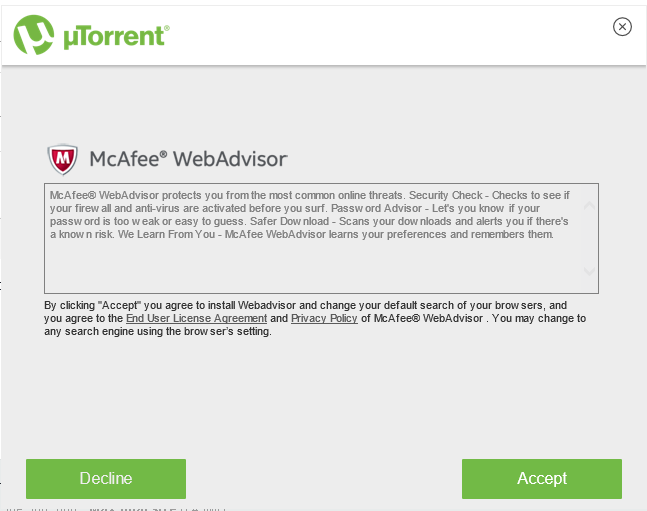
Common in software installers, misdirection presents the user with a button in the fashion of a typical continuation button. A dark pattern would show a prominent "I accept these terms" button asking the user to accept the terms of a program unrelated to the one they are trying to install. Since the user typically will accept the terms by force of habit, the unrelated program can subsequently be installed. The installer's authors do this because the authors of the unrelated program pay for each installation that they procure. The alternative route in the installer, allowing the user to skip installing the unrelated program, is much less prominently displayed, or seems counter-intuitive (such as declining the terms of service). Confusing wording may also be used to trick users into formally accepting an option which they believe has the opposite meaning. For example a personal data processing consent button using a double-negative such as " don't not sell my personal information".
Roach motel
A roach motel or a trammel net design provides an easy or straightforward path to get in but a difficult path to get out. Examples include businesses that require subscribers to print and mail their opt-out or cancellation request. Several jurisdictions have responded with easy-to-cancel mandates requiring that cancelling a subscription be no more difficult than signing up. For example, during the 2020 United States presidential election, Donald Trump's WinRed campaign employed a similar dark pattern, pushing users towards committing to a recurring monthly donation.
See also
Marketing ethics Surreptitious advertising – Stealth marketing
References
See also
Easy-to-cancel mandate
External links
Deceptive Design (formerly darkpatterns.org) Tip line to report dark patterns to the Electronic Frontier Foundation and Consumer Reports Dark patterns at the UX Pedagogy and Practice Lab at Purdue University
Text derived from https://en.wikipedia.org/w/index.php?oldid=1378596082 under CC BY-SA 4.0; modifications have been made.