Energy Vault
Energy Vault is a global energy storage company specializing in gravity and kinetic energy based, long-duration energy storage products.
≈ 4 min read
Names in other languages
No names in other languages are held for this entry yet.
Article bodies are English and are not machine-translated. A name in another language is not a translation of the article.
Energy Vault is a global energy storage company specializing in gravity and kinetic energy based, long-duration energy storage products. Energy Vault's primary product is a gravity battery to store energy by stacking heavy blocks made of composite material into a structure, capturing potential energy in the elevation gain of the blocks.
When demand for electricity is high, these blocks are lowered with the motors functioning as generators and delivering electricity to the grid.
Testing tower operation and potential
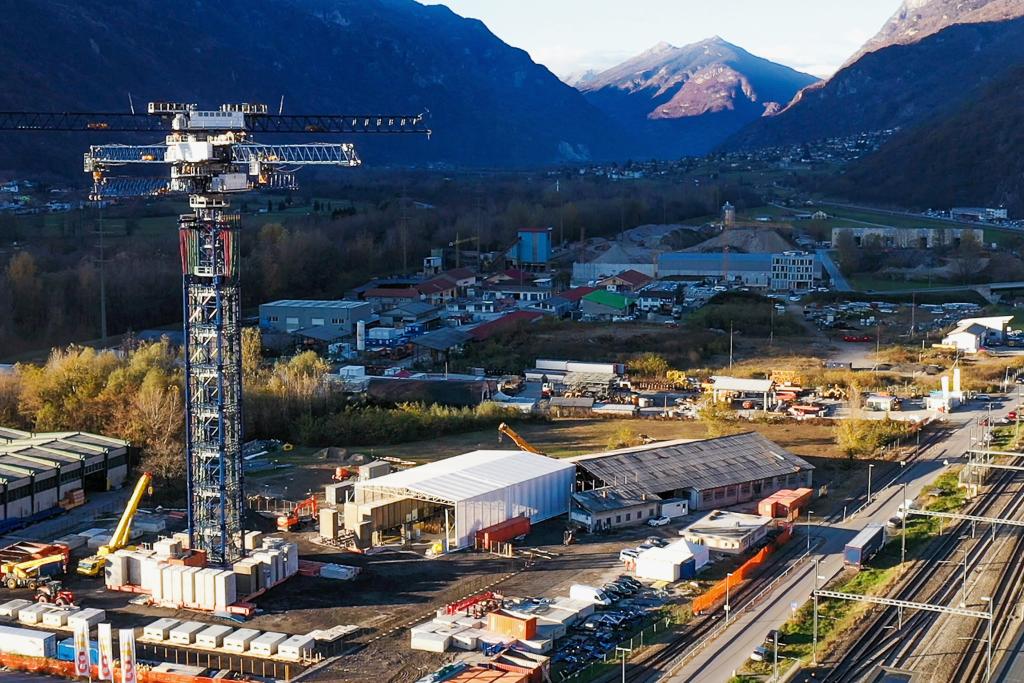
In 2019, construction of a testing tower for the case study EV1 started in Castione-Arbedo, Ticino, Switzerland. It is about 70 m high and each of the 3 double cranes up to 66 m wide. The blocks made of cement with fly ash have a mass of 35 tonnes each.
In December 2020 single blocks were raised and lowered 42 m over about 1 minute at 0.7 m/s and the energy drawn from and returned to the national grid recorded. 4.124 kWh electricity was needed to achieve the maximum theoretical potential energy of 3.906 kWh at this height, giving ~95% efficiency for this.
On lowering a production of 3.106 kWh was recorded, giving a mean production power of ~186 kW and an efficiency of ~79.5% for this, giving a total round-trip efficiency of ~75%. A photograph shows about 28 blocks available at the lowest level.
With the blocks each weighing ~340 kN and measuring assumed 5 m in height, a potential energy of 340 kN x 5 m = 1.7 MNm = ~0.47 kWh can be stored for each block raised one level. The January 2022 photograph on this page shows 8 blocks standing on the second level, 4 on the third level, and 2 on the fourth and final level.
They are thus totally storing 1.7 MNm x (8 + (2 x 4) + (3 X 2)) = 37.4 MN = ~10.4 kWh . The dimensions of the tower allow stacking at least 8 layers. The base layer stores no energy.
If the active 7 layers above have 28 blocks each, with each layer weighing ~9.5 MN, and each block can each be lowered to the ground outside the original base layer, the second layer can be lowered one level assumed 5 m, the third 10 m, the fourth 15 m, and so on. This gives a sum of 140 m x 9.5 MN = 1330 MNm = ~370 kWh. With 9 layers it would be 476 kWh.
The stacking method actually envisioned for EV1 shows outside circular layers concentric to the inner one with roughly twice its diameter. This is built up to a height about one third of the inner one. The maximum height difference of the total centers of gravity of the two stacks is then one third of the maximum height.
In the testing tower this would be 14 m. The maximum energy storable would then be 7 x 9.5 MN x 14 m = ~931 MNm = ~259 kWh. This is under 1% of the 35 MWh goal for EV1. The full size EV1 would have 7000 blocks of 35 t. Drawings show 36 layers with 200 blocks each, totaling 7000 t for the inner stack.
The bottom 14 layers are not actively usable. The upper 22 layers with a total mass of 154 kt weighing ~1510 MN are moveable and assuming 5 m high blocks have their center of gravity at 125 m height.
When they are all lowered and displaced to form an outer ring, their center of gravity is then at 35 m. Therefore the average drop is 90 m and the maximum energy storable 1.51 GN x 90 m = 136 GNm = 37.8 MWh without counting friction and conversion losses.
Text derived from https://en.wikipedia.org/w/index.php?oldid=1377369749 under CC BY-SA 4.0; modifications have been made.