Equus (play)
≈ 10 min read
Names in other languages
No names in other languages are held for this entry yet.
Article bodies are English and are not machine-translated. A name in another language is not a translation of the article.
Equus is a 1973 play by Peter Shaffer, about a child psychiatrist who attempts to treat a young man who has a pathological religious fascination with horses. Shaffer was inspired to write Equus when he heard of a crime involving a 17-year-old boy who blinded 26 horses in a small town in northern England. He set out to construct a fictional account of what might have caused the incident, without knowing any of the details of the crime, and to evoke the same "air of mystery" and "numinous" qualities as his 1964 play The Royal Hunt of the Sun but in a more modern setting. The narrative of the play follows Dr. Martin Dysart's attempts to understand the cause of the boy's (Alan Strang) actions while wrestling with his own sense of purpose and the nature of his work. The original stage production ran at the National Theatre in London from 1973 to 1975, directed by John Dexter. Alec McCowen played Dysart, and Peter Firth played Alan Strang. The first Broadway production starred Anthony Hopkins as Dysart (later played by Richard Burton, Leonard Nimoy, and Anthony Perkins) and Firth as Alan. When Firth left for Broadway, Dai Bradley took over the role of Alan in the London production, playing opposite Michael Jayston as Dr. Dysart. Tom Hulce later replaced Firth during the Broadway run. The Broadway production ran for 1,209 performances.…
Equus is a 1973 play by Peter Shaffer, about a child psychiatrist who attempts to treat a young man who has a pathological religious fascination with horses. Shaffer was inspired to write Equus when he heard of a crime involving a 17-year-old boy who blinded 26 horses in a small town in northern England. He set out to construct a fictional account of what might have caused the incident, without knowing any of the details of the crime, and to evoke the same "air of mystery" and "numinous" qualities as his 1964 play The Royal Hunt of the Sun but in a more modern setting. The narrative of the play follows Dr. Martin Dysart's attempts to understand the cause of the boy's (Alan Strang) actions while wrestling with his own sense of purpose and the nature of his work. The original stage production ran at the National Theatre in London from 1973 to 1975, directed by John Dexter. Alec McCowen played Dysart, and Peter Firth played Alan Strang. The first Broadway production starred Anthony Hopkins as Dysart (later played by Richard Burton, Leonard Nimoy, and Anthony Perkins) and Firth as Alan. When Firth left for Broadway, Dai Bradley took over the role of Alan in the London production, playing opposite Michael Jayston as Dr. Dysart. Tom Hulce later replaced Firth during the Broadway run. The Broadway production ran for 1,209 performances. Marian Seldes appeared in every single performance of the Broadway run, first in the role of Hesther and then as Dora. Shaffer would later adapt the play for a 1977 film of the same name directed by Sidney Lumet. The narrative centres on religious and ritual sacrifice themes, as well as the manner in which Strang constructs a personal theology involving the horses and the godhead "Equus". Alan sees the horses as representative of God and confuses his adoration of his "God" with sexual attraction. Also important is Shaffer's examination of the conflict between personal values and satisfaction and societal mores, expectations, and institutions, and between Apollonian and Dionysian values and systems.
Act 1
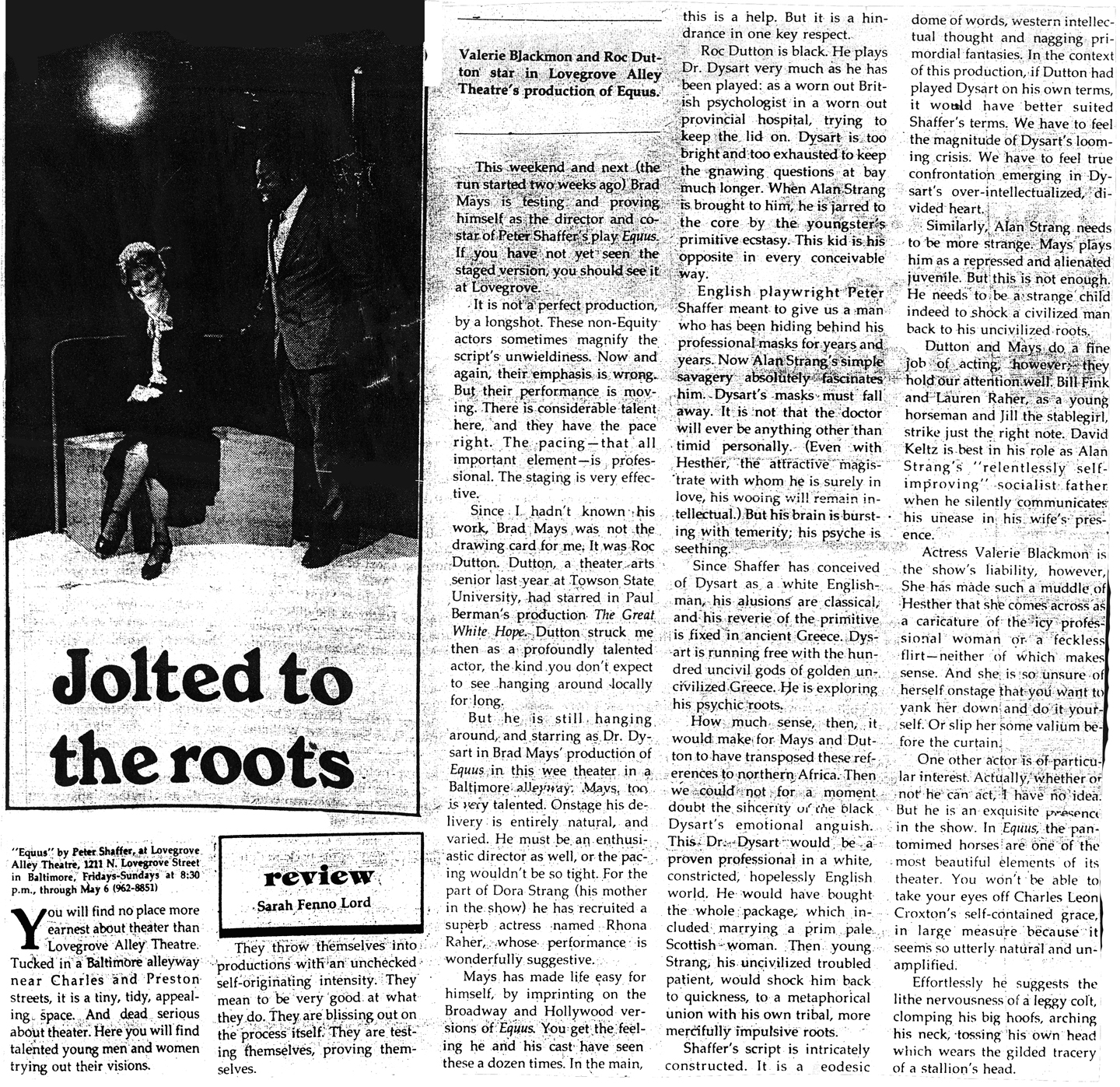
as Dysart in Equus, as directed by Brad Mays in May 1979 in Baltimore Martin Dysart is a psychiatrist working in a psychiatric hospital. He begins with a monologue in which he outlines the case of 17-year-old Alan Strang, who has blinded six horses. He divulges his feeling that his occupation is not all that he wishes it to be and his dissatisfaction and disappointment with his life. Dysart finds that the supply of troubled young people for him to "adjust" back into "normal" living is never-ending, but he doubts the value of treating these youths, since they will simply return to a dull, normal life that lacks any commitment or "worship". He comments that while Strang's crime was extreme, just such extremity is needed to break free from the chains of existence. A court magistrate, Hesther Saloman, visits Dysart, believing that he has the skills to help Alan come to terms with what he did. At the hospital, Dysart struggles to engage with Alan, who at first responds to questioning by singing TV advertising jingles. Dysart reveals a dream he has had, in a Homeric Grecian setting, in which he is a public official presiding over a mass ritual sacrifice. One after another, he slices open the abdomens of hundreds of children and pulls out their entrails. He becomes disgusted with what he is doing, but fears being murdered in the same manner if discovered as a "non-believer" by the other priests, and so continues. Eventually the other priests become aware of his misgivings and grab the knife from his hand, at which point he awakens from the dream. Dysart interviews Alan's parents. He learns that, from an early age, Alan has been receiving conflicting views on religion from his parents. Alan's mother, Dora, is a devout Christian who has read to him daily from the Bible, but this practice has antagonized Alan's father Frank, a non-believer. Slowly, Dysart makes contact with Alan by playing a game where each of them asks a question, which must be answered honestly. Dysart learns that Frank, concerned that Alan was taking far too much interest in the more violent aspects of the Bible, destroyed a violent picture of the crucifixion of Jesus that Alan had hung at the foot of his bed. Alan then replaced the picture with one of a horse, with large, staring eyes. Alan reveals to Dysart that, during his youth, his attraction to horses came about by way of his mother's Biblical tales, a horse story that she had read to him, Western films, and his grandfather's interest in horses and riding. Alan's sexual education began with his mother, who told him that he could find true love and contentment by way of religious devotion and marriage. During this time, Alan also began to develop a sexual attraction to horses, desiring to pet their coats, feel their muscular bodies, and smell their sweat. Alan reveals to Dysart that he had first encountered a horse at age six, on the beach. A rider approached him, and took him up on the horse. Alan was visibly excited, but his parents found him and Frank pulled him violently off the horse; the horse rider scoffed at Frank and rode off. Dysart hypnotizes Alan, during which he reveals elements of his dream about human sacrifice. He begins to jog Alan's memory by filling in blanks and asking questions. Alan reveals that he wants to help captive horses by removing the bit, which enslaves them. After turning 17, Alan took a job working in a shop selling electrical goods, where he met Jill Mason, an outgoing and free-spirited young woman who works for a local stable owner. She visited the shop wanting to purchase blades for horse-clippers, which piqued Alan's interest. Jill suggested that Alan work for Harry Dalton, the owner of the stables, to which Alan agreed. Dysart meets with Dalton, who tells him that he first held Alan to be a model worker, since he kept the stables immaculately clean and groomed the horses, including one named Nugget. Through Dysart's questioning, it becomes clear that Alan is erotically fixated on Nugget (or "Equus") and secretly takes him for midnight rides, bareback and naked. Alan envisions himself as a king astride the godhead Equus, both destroying their enemies.
Act 2
as Jill and Alan in Equus, as directed by Mays in May 1979 in Baltimore Dysart gives Alan a placebo "truth pill". Revealing a tryst with Jill, Alan begins to re-enact the event: Jill, who has taken an interest in Alan, asks him to take her to an adult movie theater. While there, they run into Frank. Alan is traumatized, particularly when he realizes that his father is lying to justify his presence in the theatre; however, this allows Alan to realize that sex is a natural thing for all men, even his father. Alan walks Jill home after they leave and she convinces Alan to come to the stables with her. Once there, Jill seduces Alan and the two undress and attempt to have sex. However, Alan hesitates when he hears the horses making noises in the stables beneath, and he is unable to get an erection. Jill tries to ask Alan what the problem is, but he shouts at her to leave. After Jill dresses and walks out of the stables, the still-nude Alan begs the horses for forgiveness. "Mine!...You're mine!...I am yours and you are mine!" cries Equus through Dysart's voice, but then he becomes threatening: "The Lord thy God is a jealous God," Equus/Dysart seethes, "He sees you, he sees you forever and ever, Alan. He sees you!...He sees you!" Alan screams, "God seest!" and then says "No more. No more, Equus!" Alan then uses a steel spike to blind the six horses in the stable, whose eyes have "seen" his very soul. In the final scene, Dysart delivers a monologue questioning the fundamentals of his practice and whether his methods will help Alan, as the effect of his treatment will make him normal, but at the cost of his humanity.
Awards and nominations
Original Broadway production
Text derived from https://en.wikipedia.org/w/index.php?oldid=1378800825 under CC BY-SA 4.0; modifications have been made.