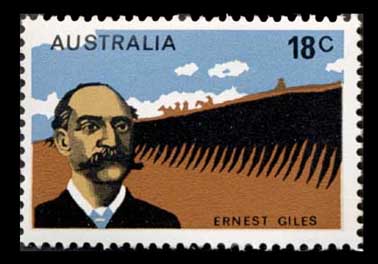
Ernest Giles
William Ernest Powell Giles (20 July 1835 – 13 November 1897), best known as Ernest Giles, was an Australian explorer.
≈ 3 min read
Names in other languages
No names in other languages are held for this entry yet.
Article bodies are English and are not machine-translated. A name in another language is not a translation of the article.
William Ernest Powell Giles (20 July 1835 – 13 November 1897), best known as Ernest Giles, was an Australian explorer. He led five major expeditions to parts of South Australia and Western Australia.
First Expedition
Giles did not attempt an organised expedition until 22 August 1872, when he left Chambers Pillar with two other men and traversed much uncharted country to the north-west and west, along the Finke River, through the Krichauff Range and then to Mount Udor. He then turned south, encountering a freshwater spring surrounded by caves filled with Aboriginal rock art. Giles denigrated the paintings, stating they were childish manifestations created by "reptile-eating Troglodytes".
A member of his group, Samuel Carmichael, then proceeded to vandalise the rock drawings "with a few choice specimens of the white man's art". Finding their way barred by Lake Amadeus and that their horses were getting very weak, they decided to return. Giles viewed Kata Tjuta from Lake Amadeus, which he named Mount Olga after the Queen of Spain.
His group returned to Charlotte Waters and then to Adelaide. Giles was the first European to see the rock formations named The Olgas, now officially known by Kata Tjuta/Mount Olga, and Lake Amadeus.
He had wanted to name these Mt Mueller and Lake Ferdinand respectively, to honour his benefactor Baron Ferdinand von Mueller, however Mueller prevailed on him to instead honour the King Amadeus of Spain and Queen Olga of Württemberg. Giles was beaten to viewing Uluru by a competing explorer, William Gosse.
Family
His parents were William Giles (c. 1795 – 28 May 1860) of HM Customs, Victoria and Jane Elizabeth Giles, née Powell (c. 1804 – 15 March 1879). He had five sisters, one of these was Jane Rebecca Giles, and the George Gill Range was named by Giles in honour of her husband. His other sisters included Helen Sarah Giles, Harriet Eliza Giles, and Alice Mary Giles.
His brother was Robert Eugene Giles of Hamilton, Victoria, who accepted the Royal Geographical Society medal on his brother's behalf. He was later jailed for misappropriation while trustee, before moving to Adelaide, from where he continued to promote his brother's memory. Ernest Giles was not related to another explorer Alfred Giles, though they knew each other professionally.
Plant names
The unrelated Christopher Giles (c. 1841–1917) assisted Giles's 1872–73 and 1873–74 expeditions, collecting plants for von Mueller in the region of Charlotte Waters. Specimens collected by E. Giles are cared for at the National Herbarium of Victoria (MEL), Royal Botanic Gardens Victoria.
The genus Gilesia, which contains one species, Gilesia biniflora , the western tar-vine, is named for both Christopher and Ernest Giles. Cyperus gilesii and Panicum gilesii are usually listed as honouring Ernest Giles, but the type details for both species are given by George Bentham only as "Central Australia. Charlotte Waters, Giles".
Christopher Giles was honoured in the species Eremophila christopheri, the dolomite fuchsia bush, whereas the desert fuchsia, Eremophila gilesii, which is widespread across the region, honours Ernest. A species of wattle, Acacia gilesiana, is named for Ernest Giles.
Text derived from https://en.wikipedia.org/w/index.php?oldid=1368707737 under CC BY-SA 4.0; modifications have been made.