Floppy disk
≈ 11 min read
Names in other languages
No names in other languages are held for this entry yet.
Article bodies are English and are not machine-translated. A name in another language is not a translation of the article.
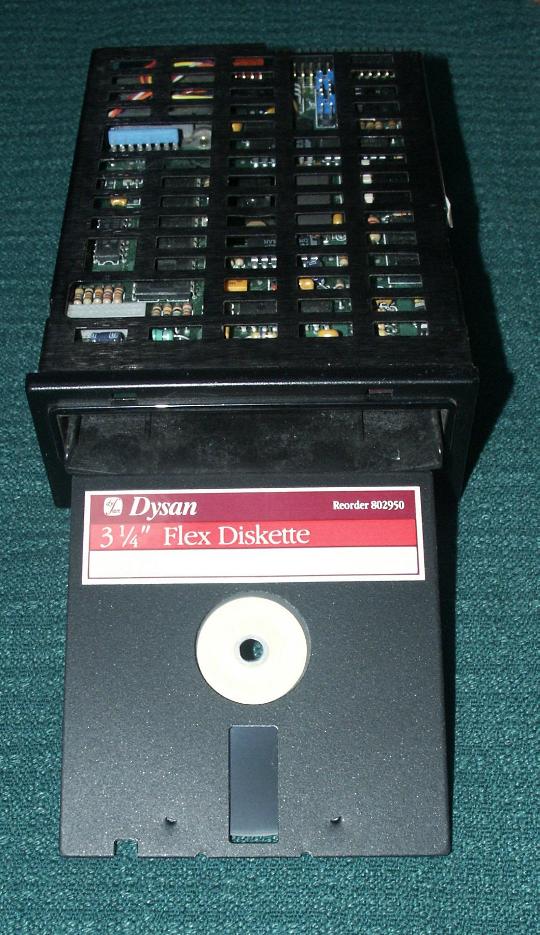
A floppy disk, diskette, or floppy diskette is a type of disk storage made from a thin, flexible disk coated with a magnetic storage medium. It is enclosed in a square or nearly square plastic shell lined with fabric to help remove dust from the spinning disk. Floppy disks store digital data, which can be read or written when inserted into a floppy disk drive (FDD) connected to or built into a computer or other device. The three most popular formats of floppy disks (and their drives) are the 8-inch, 5¼-inch, and 3½-inch versions. The first floppy disks, invented and made by IBM in 1971, had a disk diameter of . Subsequently, the 5¼-inch (130 mm) and then the 3½-inch (90 mm) became a ubiquitous form of data storage and data transfer into the first years of the 21st century. By the end of the 1980s, 5¼-inch (130 mm) disks had been superseded by 3½-inch (90 mm) disks. During this time, PCs frequently came equipped with drives of both sizes. By the mid-1990s, 5¼-inch drives had virtually disappeared, the 3½-inch disk became the dominant format. The advantages of the 3½-inch (90 mm) disk were its higher capacity, smaller physical size, and its rigid case which provided better protection from dirt and other environmental risks.…
A floppy disk, diskette, or floppy diskette is a type of disk storage made from a thin, flexible disk coated with a magnetic storage medium. It is enclosed in a square or nearly square plastic shell lined with fabric to help remove dust from the spinning disk. Floppy disks store digital data, which can be read or written when inserted into a floppy disk drive (FDD) connected to or built into a computer or other device. The three most popular formats of floppy disks (and their drives) are the 8-inch, 5¼-inch, and 3½-inch versions. The first floppy disks, invented and made by IBM in 1971, had a disk diameter of . Subsequently, the 5¼-inch (130 mm) and then the 3½-inch (90 mm) became a ubiquitous form of data storage and data transfer into the first years of the 21st century. By the end of the 1980s, 5¼-inch (130 mm) disks had been superseded by 3½-inch (90 mm) disks. During this time, PCs frequently came equipped with drives of both sizes. By the mid-1990s, 5¼-inch drives had virtually disappeared, the 3½-inch disk became the dominant format. The advantages of the 3½-inch (90 mm) disk were its higher capacity, smaller physical size, and its rigid case which provided better protection from dirt and other environmental risks. Floppy disks were so common in late 20th-century culture that many electronic and software programs continue to use save icons that look like floppy disks well into the 21st century, as a form of skeuomorphic design. While floppy disk drives still have some limited uses, especially with legacy industrial computer equipment, they have been superseded by data storage methods with much greater data storage capacity and data transfer speed, such as USB flash drives, memory cards, optical discs, and storage available through local computer networks and cloud storage. 1) Hole indicates a high-capacity disk. 2) Hub engages with the drive motor. 3) Shutter protects the surface. 4) Plastic housing. 5) Polyester sheet reduces friction. 6) Magnetic-coated plastic disk. 7) Schematic of one sector (tracks/sectors not visible on real disks). 8) Write protection tab. In the early 1980s, many manufacturers introduced smaller floppy drives and media in various formats. A consortium of 21 companies eventually settled on a design known as the Micro diskette, Micro disk, or Micro floppy, similar to a Sony design but improved to support both single-sided and double-sided media, with formatted capacities generally of 360 kB and 720 kB respectively. Single-sided drives of the consortium design first shipped in 1983, and double-sided in 1984. The double-sided, high-density 1.44 MB (actually 1440 KiB = 1.41 MiB or 1.47 MB) disk drive, which would become the most popular, first shipped in 1986. IBM started using the 720 KB double density microfloppy disk on its Convertible laptop computer in 1986 and the 1.44 MB (1,474,560 bytes) high-density version with the IBM Personal System/2 (PS/2) line in 1987. These disk drives could be added to older PC models. In 1988, Y-E Data introduced a drive for 2.88 MB Double-Sided Extended-Density (DSED) diskettes which was used by IBM in its top-of-the-line PS/2 and some RS/6000 models and in the second-generation NeXTcube and NeXTstation; however, this format had limited market success due to lack of standards and movement to 1.44 MB drives. The first Macintosh computers used single-sided floppy disks, but with 400 kB formatted capacity. These were followed in 1986 by double-sided 800 kB floppies. The higher capacity was achieved at the same recording density by varying the disk-rotation speed with head position so that the linear speed of the disk was closer to constant. Later Macs could also read and write 1.44 MB HD disks in PC format with fixed rotation speed. Higher capacities were similarly achieved by Acorn's RISC OS (800 kB for DD, 1,600 kB for HD) and AmigaOS (880 kB for DD, 1,760 kB for HD). Most disks have a rectangular hole in one corner which, if obstructed, write-enables the disk. A sliding detented piece can be moved to block or reveal the part of the rectangular hole that is sensed by the drive. The HD 1.44 MB disks have a second, unobstructed hole in the opposite corner that identifies them as being of that capacity. In IBM-compatible PCs, higher-density floppy drives can read lower-density media, but writing and formatting across densities has reliability issues and was not officially supported by manufacturers. Writing at different densities than those at which disks were intended, sometimes by altering the density detection hole, was possible but not supported by manufacturers. A hole on one side of a disk can be altered to make some disk drives and operating systems treat the disk as one of higher or lower density, for bidirectional compatibility or economic reasons. Some computers, such as the PS/2 and Acorn Archimedes, ignored these holes altogether. Generally, the term floppy disk persisted, even though later style floppy disks have a rigid case around an internal floppy disk.
High-capacity
A number of attempts were made by various companies to introduce newer floppy-disk formats, frequently characterized as a "super floppy," with many based on the standard 3½-inch physical form while offering much higher capacity. Many of these products provide the ability to read and write standard DD and HD disks. Some manufacturers offered high‑capacity floppy disk drives as standard components on their PCs (e.g. SuperDisk), but these drives never achieved the level of industry‑wide standardization reached by earlier floppy disk designs. They were later largely replaced first by optical disc burners and then by flash storage. In 1990, an attempt was made to standardize details for a 20MB 3½-inch format floppy. At the time, "three different technologies that are not interchangeable" existed. One major goal was that the to-be-developed standard drive be backward compatible: that it be able to read 720 KB and 1.44 MB floppies.
High-capacity disks
The main technological change for the higher-capacity formats was the addition of tracking information on the disk surface to allow the read/write heads to be positioned more accurately. Most earlier generations of floppy disks have no such information, so the drives use open loop positioning by a stepper motor in order to position their heads over the desired track. For good interoperability of disks among drives, this requires precise alignment of the drive heads to a reference standard, somewhat similar to the alignment required to get the best performance out of an audio tape deck. The newer systems generally use position information on the surfaces of the disk to find the tracks, allowing the track width to be greatly reduced. The following summarizes specific structural differences in the several high-capacity FDs with more details contained in linked articles: Floptical The Floptical drive can read from and write 720 kB and 1.44 MB 3½-inch disks and uses infra-red LED to position the heads over marks in the disk surface to achieve a capacity of 21 MB on its high-capacity floppy disks. The drives are attached to the system using the SCSI interface instead of the usual floppy controller interface. It is considered to be the first actual super floppy. and its technology was licensed to a number of companies, who introduced compatible devices as well as even larger-capacity formats. The most popular of these, by far, was the LS-120. Flextra The Brier Flextra BR3020 announced at 21.4 MB could read and write 720 KB and 1.44 MB 3½-inch disks. Zip disk Physically both the media and cartridge were slightly larger but similar to other 3½-inch media and cartridges. A linear actuator positioned flying heads over high-capacity media that started at 100 MB and grew to 700 MB. It was offered in a variety of interfaces including PATA. LS-120/LS-240 LS, for LASER-servo, uses a LED to generate light that allows the drive to align its heads on high capacity FD media, initially at 120 MB and subsequently at 240 MB. The drive read and write 3½-inch 1,440 KB floppy disks, and some versions of the drive can write 32 MB onto a 3½-inch 1,440 kB disk albeit not too reliably. It was offered in a variety of interfaces including PATA. Sony HiFD Structurally similar to the Floptical and initially at 150 MB, it was removed from the market and subsequently reintroduced at 200 MB Caleb UHD144 Structurally similar to the Floptical it provides 144 MB of storage and is capable reading and writing 720 kB and 1.44 MB 3½-inch disks.
Further reading
Weyhrich, Steven (2005). "The Disk II": A detailed essay describing one of the first commercial floppy disk drives (from the Apple II History website). Immers, Richard; Neufeld, Gerald G. (1984). Inside Commodore DOS: The Complete Guide to the 1541 Disk Operating System. Datamost & Reston Publishing Company (Prentice-Hall). . Englisch, Lothar; Szczepanowski, Norbert (1984). The Anatomy of the 1541 Disk Drive. Grand Rapids, Michigan, USA, Abacus Software (translated from the original 1983 German edition, Düsseldorf, Data Becker GmbH). . Hewlett Packard: 9121D/S Disc Memory Operator's Manual; printed 1 September 1982; part number 09121-90000.
Text derived from https://en.wikipedia.org/w/index.php?oldid=1376374018 under CC BY-SA 4.0; modifications have been made.