Ford Pinto
The Ford Pinto is a subcompact car that was manufactured and marketed by Ford Motor Company in North America from 1970 until 1980.
≈ 20 min read
Names in other languages
No names in other languages are held for this entry yet.
Article bodies are English and are not machine-translated. A name in another language is not a translation of the article.
The Ford Pinto is a subcompact car that was manufactured and marketed by Ford Motor Company in North America from 1970 until 1980. The Pinto was the first subcompact vehicle produced by Ford in North America. The Pinto was marketed in three body styles across its production: a two-door fastback sedan with a trunk, a three-door hatchback, and a two-door station wagon.
Mercury offered rebadged versions of the Pinto as the Mercury Bobcat from 1975 until 1980 (1974–1980 in Canada ). Over three million Pintos were manufactured over its ten-year production run, outproducing the combined totals of its domestic rivals, the Chevrolet Vega and the AMC Gremlin.
Along with the Pinto, approximately 224,000 Bobcats were manufactured from 1975 until 1980, at Edison Assembly in Edison, New Jersey, St. Thomas Assembly in Southwold, Ontario, and San Jose Assembly in Milpitas, California. In the 1970s, the safety reputation of the Pinto became a point of controversy.
The design of the car's fuel tank attracted intense media and government scrutiny after several deadly fires following fuel tank ruptures associated with rear-end collisions. Subsequent analysis of the design's overall safety suggested it was comparable to other 1970s subcompact cars.
The safety issues surrounding the Pinto and the subsequent response by Ford have been cited widely as business ethics and tort reform case studies.
Background
American automakers had first countered imports such as the Volkswagen Beetle with compact cars including the Ford Falcon, Ford Maverick, Chevrolet Corvair and Plymouth Valiant, although these cars featured six-cylinder engines and comprised a larger vehicle class. As the popularity of smaller Japanese imports Toyota Corolla and Datsun 510 increased throughout the 1960s, Ford North America responded by introducing the Cortina from Ford of Europe as a captive import.
American automakers introduced their subcompacts, led by the AMC Gremlin that arrived six months before the Pinto, and the Chevrolet Vega, introduced the day before the Pinto. Named after a type of horse with a distinctive coat, the Pinto was introduced on September 11, 1970, using a completely new platform along with a powertrain from the European-specification Escort.
Ford Chairman Henry Ford II himself purchased a 1971 Runabout (hatchback) as one of his personal cars.
Production history
On September 11, 1970, Ford introduced the Pinto under the tagline The Little Carefree Car. After structural design on alternate body styles encountered obstacles, Ford offered the Pinto solely as a two-door sedan, with entry-level models priced at $1,850, undercutting GM's Chevrolet Vega and directly targeting imported models – which included such new competitors as the Mazda 1200 in 1971, the Subaru DL in 1972, and the Honda Civic in 1973.
The Pinto had sold over 100,000 units by January 1971, and 352,402 for the entire 1971 production run; 1974 saw the most Pintos produced in a single model year, with 544,209 units.
1971–1973
The Ford Pinto went on sale on September 11, 1970, in one body style, a fastback sedan with an enclosed trunk. A hatchback became available on February 20, 1971, debuting at the Chicago Auto Show. In 1971, the Pinto brochure came with a paper cutout Pinto that one could fold to make a 3D model.
Marketed as the Runabout, the hatchback went on sale five days later, priced at $2,062 ($ in dollars ). The hatch itself featured exposed chrome hinges for the liftgate and five decorative chrome strips, sprung scissor struts to assist in opening the hatch, a rear window approximately as large as the sedan's, and a fold-down seat – a feature which concurrently became optional on the sedan.
The hatchback model matched the sedan in all other dimensions and offered of cargo space with its seat folded. By 1972, Ford redesigned the hatch itself, with the glass portion of the hatch enlarged to almost the entire size of the hatch itself, ultimately to be followed by an optional rear hatch that was entirely glass, for model years1977–1980.
On October 30, 1970, less than two months after introduction, 26,000 Pintos were recalled to address a possible problem with the accelerator sticking on once engaged at more than halfway. On March 29, 1971, Ford recalled all 220,000 Pintos manufactured before March 19, 1971, to address a problem with fuel vapors in the engine air filter possibly igniting by a backfire through the carburetor.
On February 24, 1972, the Pinto station wagon debuted with an overall length of and of cargo volume. The first 2-door Ford station wagon since the 1965 Falcon, the Pinto wagon was equipped with flip-open rear quarter windows. Along with front disc brakes, the 2.0L engine was standard equipment.
A Pinto Squire wagon featured simulated woodgrain trim similar to the full-size Country Squire. Also in February 1972, the Sprint Decor Group was made available for the Pinto for one model year only.
The Sprint Decor Group included white exterior paint with blue accent paint and red pin-striping, a blacked-out grille, color-keyed wheels with bright trim rings and hubcaps, whitewall tires, and color-keyed dual sport mirrors. The interior included red, white, and blue cloth and vinyl bucket seats, full carpeting as well as a deluxe steering wheel.
The Sprint Decor Group was offered simultaneously on the Maverick and Mustang. For the 1973 model year, more appearance options were offered. There was a new Sport Accent Group offered in white exterior paint with a choice of two-tone orange or avocado accent paint, matching vinyl roof, and a deluxe interior with wood-tone trim.
There was also a new Luxury Decor Group with bright exterior dress-up mouldings, black bumper rub strips, and a deluxe interior with wood-tone trim. New slotted forged aluminum wheels were offered.
1974–1978
In 1974, to meet federal regulations, 5 mph bumpers were added to both the front and rear. Unlike most 1970s cars, the addition of larger bumpers to the Pinto did not necessitate major changes to the bodywork. While the underpowered Kent engine was dropped, the optional OHC engine was expanded to 2.3 L; in various forms, this engine powered a variety of Ford vehicles for 23 years.
In 1974, Mercury began selling a rebadged version of the Pinto called Bobcat as a Canada-only model. 544,209 units sold; 1974 became the most popular model year for the Pinto. Steel-belted tires, an anti-theft alarm system, and metallic glow paint were optional.
In 1975, in a move to better compete with the AMC Gremlin, Ford introduced the 2.8 L V6; while far less powerful than the Gremlin's standard I6, the V6 gave the Pinto a feature unavailable in the Chevrolet Vega. Sales of the Mercury Bobcat were expanded to Lincoln-Mercury dealers in the United States; it was sold as a hatchback and station wagon.
As a minor styling update for 1976, the Pinto received the egg-crate grille and chrome headlamp bezels recycled from the Canada-only 1974 Mercury Bobcat. For one model year only, two new option packages were offered. One was the sporty new Stallion appearance package with blackout trim and black two-tone accent paint offered in red, yellow, silver, and white body colors.
This option package was shared with the Mustang II and Maverick. The other new option package was the Runabout Squire which featured wood-grain vinyl bodysides like the Squire wagon. The interior received the optional Luxury Decor Group which featured new low-back vinyl or plaid cloth bucket seats with matching door trim.
A new basic low-cost model was introduced known as the Pinto Pony with less standard equipment and cheaper interior trim. A wagon version of the Pony would later arrive for the 1979 model year. For the 1977 model year, the Pinto received its first significant styling updates with slanted back urethane headlamp buckets, parking lamps, and grille.
The tail lamps were revised except for the wagons. Runabouts offered an optional all-glass rear hatch for the first time. Pinto wagons were given a new option package.
Dubbed the Pinto Cruising Wagon, it was the sedan delivery version of the Pinto styled to resemble a small conversion van, complete with round side panel "bubble windows" and a choice of optional vinyl graphics. Ford offered new sporty appearance packages similar to those found on the Chevrolet Vega and AMC Gremlin but were strictly cosmetic upgrades that added nothing to vehicle performance.
In 1978, the Pinto was no longer the smallest Ford sold in the U.S., as the company introduced the Fiesta. Nearly two feet shorter than the Pinto, the German-designed Fiesta was the first front-wheel-drive car sold by Ford in the United States.
File:1974 Ford Pinto two-door wagon, rear left.jpg|1974 Ford Pinto station wagon File:1976 Ford Pinto (9912822385).jpg|1976 Ford Pinto Runabout File:1978 Ford Pinto hatchback at 2015 Rockville Show 2of5.jpg|1977–1978 Ford Pinto Runabout File:Turbo Pinto (14430994634).jpg|1977–1978 Ford Pinto Runabout with optional all-glass hatch File:1978 Ford Pinto Cruising Wagon, front left.jpg|1977–1978 Ford Pinto Cruising Wagon File:2022 Downtown West Allis Classic Car Show 085 (1978 Ford Pinto Squire Wagon).jpg|1978 Ford Pinto Squire Wagon
1979–1980
For the 1979 model year, the Pinto featured rectangular headlamps, inboard vertical parking lamps, and a taller slanted back grille. Except for the wagons, the tail lamps were revised. The interior was updated with a new rectangular instrument cluster and a modified dash-pad for vehicles without the optional sports instrumentation.
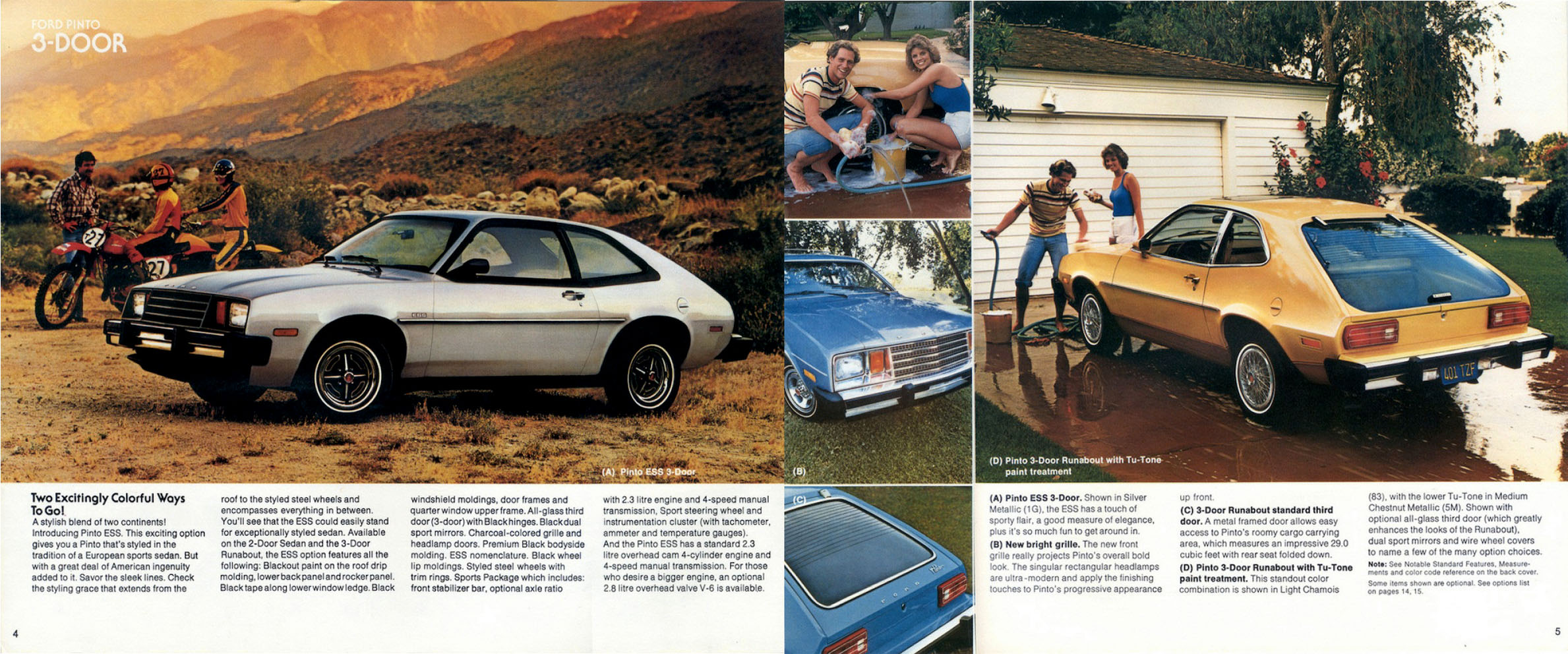
The variety of sports appearance packages was revised, some with new graphics. The Pinto ESS (European Sports Sedan) trim package became available in 2-door Sedan and 3-door Runabout body styles featuring black roof drip mouldings, lower back panel, rocker panels, glass surrounds and door frame trims (incl. black tape along lower side window ledges), dual sport mirrors, premium body-side mouldings, and hinges for the standard all-glass third door.
The grille and headlamp surrounds were charcoal, the fenders had ESS identification and the styled steel wheels had black wheel trim rings. The Sports Package (front stabilizer bar, sport steering wheel, full instrumentation, optional axle ratio on 2.3L manual cars) was standard. July 1980 marked the end of the Pinto's production run, with a total production run of 3,150,943 cars.
Ford's designated replacement for the Pinto was the front-wheel drive Ford Escort. For the 1980 model year, the V6 engine was discontinued, leaving the 2.3 L as the sole engine.
Powertrain
Except for 1980, the Pinto was available with a choice of two engines. For the first five years of production, only four-cylinder inline engines were offered. Ford changed the power ratings almost every year.
Initial Pinto deliveries in the early years used the English and German engines tuned for performance (see below). The engine used a two-barrel carburetor where just one bore was bigger than that used on the Maverick. With the low weight (not much above ) and the SOHC engine it accelerated from in 10.8 seconds.
With the advent of emission control requirements, Ford moved from European-sourced to domestically sourced engines, using new or modified designs. New safety legislation affected bumpers and other parts, adding to the weight of the car and reduced performance. Revised SAE standards in 1972 dropped the Pinto's engine to – and the engine to .
In 1974, the OHC I4 engine was introduced. This engine was updated and modified several times, allowing it to remain in production into 1997. Among other Ford vehicles, a turbocharged version of this engine later powered the performance-based Thunderbird Turbo Coupe, Mustang SVO, and the European-built Merkur XR4Ti.
Ford introduced the Cologne-built 2.8 litre V-6 engine as an option in 1975.
Mercury Bobcat (1974–1980)
Lincoln-Mercury dealers introduced a rebadged variant of the Pinto as the Mercury Bobcat, for model year 1974, beginning with the Canadian market. Offered in the same body styles as the Pinto, the Bobcat was distinguished by an egg-crate grille and chrome headlamp bezels. The rear featured modified double-width tail lamps for the sedan and Runabout models.
For 1975, the Bobcat was added to the U.S. market and sold initially in upgraded levels of trim as the Runabout hatchback and Villager wagon. Lesser-trimmed versions were offered in subsequent model years. The Bobcat was never offered as a two-door sedan with an enclosed trunk for the U.S. market.
The Bobcat was offered as a two-door sedan for a limited number of years in Canada. All Bobcats were restyled with a raised hood and a taller vertical bar grille.
Across all model years, Bobcats offered various appearance options, similar to the Pinto's. For 1979, the Bobcat received a major restyling shared with the Pinto featuring a slanted back front end with rectangular headlamps and inboard vertical parking lamps but distinguished with a large vertical bar grille. Except for the wagons, the tail lamps were revised.
The base instrument cluster received a new rectangular design with a modified dash pad. Production of the Bobcat ended in 1980, superseded by the Mercury Lynx. In total, 224,026 Bobcats were manufactured from 1975 until 1980.
File:1977 Mercury Bobcat wagon.jpg|1977 Mercury Bobcat wagon File:Rear of 1977 Mercury Bobcat wagon.jpg|1977 Mercury Bobcat Villager wagon File:Mercury Bobcat Runabout 1978 (15482996372).jpg|1975–1978 Mercury Bobcat Runabout File:Mercury Bobcat Pincat.JPG|1979–1980 Mercury Bobcat Runabout
Reception and criticism
Upon release, the Pinto was received with both positive and negative reviews. Consumer Reports listed the Pinto as one of the "runners up" in a test of six subcompact cars—better in overall quality than the AMC Gremlin and about on a par with the Volkswagen Beetle, but inferior to the "three winners" — Datsun 510, Toyota Corona and Chevrolet Vega.
Road & Track faulted the suspension and standard drum brakes, calling the latter a "serious deficiency", but praised the proven 1.6 L Kent engine, adapted from European Fords. Super Stock Magazine found the fit and finish to be "superior" and were impressed with the car overall.
Car and Driver found the Pinto, when equipped with the larger 2.0L engine and front disc brakes, to be a nimble and powerful commuter car with good visibility and sports-car feel. A review of the 1974 Pinto with an automatic transmission by Car and Driver was not as favorable noting significant decreases in mileage and acceleration.
The later controversy surrounding the Pinto resulted in a negative legacy associated with the car and Ford's handling of the controversies. In 2004, Forbes included the Pinto among its fourteen Worst Cars of All Time, noting that its problems helped create an opening in the US market for small cars from Japan. Time magazine included the Pinto on lists of The Fifty Worst Cars of All Time.
Time, Popular Mechanics, and NBC News have included the car in lists of most significant recalls. The controversy also resulted in movies referencing the vehicle.
Fuel system design
The design of the Pinto fuel system was complicated by the uncertain regulatory environment during the development period. The first federal standard for automotive fuel system safety, passed in 1967, known as Section 301 in the Federal Motor Vehicle Safety Standards, initially only considered front impacts.
In January 1969, 18 months into the Pinto's development cycle, the NHTSA proposed expanding the standard to cover rear-end collisions. The proposed standard was based on a moving-barrier rear impact test. Ford publicly announced it supported the standard.
In August 1970, the month the Pinto went into production, the NHTSA changed the proposal to a more stringent fixed-barrier standard which car companies were to meet in 18 months. The fixed-barrier standard was seen by the auto industry as a significant increase in test severity. At the same time, the NHTSA announced a long-term goal of setting a fixed-barrier standard.
Due to the confusion related to the various proposed standards and an expectation that the NHTSA would not select the more stringent fixed-barrier standard, Ford elected to voluntarily meet the moving-barrier standard for all cars by 1973. Ford and other automobile manufacturers objected to the more stringent fuel system safety standard and filed objections during the required comment periods of the proposed regulations.
The Pinto's design positioned its fuel tank between the solid live rear axle and the rear bumper, a standard practice in US subcompact cars at the time. The Pinto's vulnerability to fuel leakage and fire in a rear-end collision was exacerbated by reduced rear "crush space", a lack of structural reinforcement in the rear, and an "essentially ornamental" rear bumper (though similar to other manufacturers).
As part of a response to the NHTSA's proposed regulations, crash testing conducted in 1970 with modified Ford Mavericks demonstrated vulnerability at fairly low crash speeds. Design changes were made, but post-launch tests showed similar results. These tests were conducted to develop crash testing standards rather than specifically investigating fuel system integrity.
Though Ford engineers were not pleased with the car's performance, no reports of the time indicate particular concern. The Pinto was tested by rival American Motors (AMC) where in addition to crash-testing, engineers specialized in fuel-system performance because of the potential deadly fires in severe collisions.
Ford also tested several different vehicle modifications that could improve rear impact performance. However, the engineer's occupational caution and aversion to "unproven" solutions, as well as a view that the crash test results were inconclusive, resulted in the use of a conventional fuel tank design and placement.
The use of an above-the-axle tank location was considered safer by some, but not all, at Ford. This placement was not a viable option for the hatchback and station wagon body styles. Beginning in 1973, field reports of Ford Pintos consumed by fire after low-speed rear-end collisions were received by Ford's recall coordinator office.
Based on standard procedures used to evaluate field reports, Ford's internal recall evaluation group twice reviewed the field data and found no actionable issue.
Recall
Though Ford could have proceeded with the formal recall hearing, fearing additional damage to the company's public reputation, the company agreed to a "voluntary recall" program. On June 9, 1978, days before the NHTSA was to issue Ford a formal recall order, Ford recalled 1.5 million Ford Pintos and Mercury Bobcats, the largest recall in automotive history at the time.
The recall included sedans and hatchbacks, but not the station wagon. Ford disagreed with the NHTSA finding of a defect, and said the recall was to "end public concern that has resulted from criticism of the fuel systems in these vehicles."
The Ford recall placed a polyethylene shield between the tank and likely causes of puncture, lengthened the filler tube, and improved the tank filler seal in the event of a collision.
Retrospective safety analysis
A Rutgers Law Review article by former UCLA law professor Gary T. Schwartz (see Section 7.3 NHTSA Investigation above), examined the fatality rates of the Pinto and several other small cars of the time. He noted that fires, and rear-end fires, in particular, are a very small portion of overall auto fatalities.
At the time only 1% of automobile crashes would result in fire and only 4% of fatal accidents involved fire, and only 15% of fatal fire crashes are the result of rear-end collisions. When considering the overall safety of the Pinto, subcompact cars as a class had a generally higher fatality risk. Pintos represented 1.9% of all cars on the road in the 1975–76 period.
During that time, the car represented 1.9% of all "fatal accidents accompanied by some fire". This implies the Pinto was average for all cars and slightly above average for its class. When all types of fatalities are considered, the Pinto was approximately even with the AMC Gremlin, Chevrolet Vega, and Datsun 510.
It was significantly better than the Datsun 1200/210, Toyota Corolla, and VW Beetle. The safety record of the car in terms of fire was average or slightly below average for compacts, and all cars respectively. This was considered respectable for a subcompact car.
Only when considering the narrow subset of a rear impact, fire fatalities for the car were somewhat worse than the average for subcompact cars. While acknowledging this is an important legal point, Schwartz rejected the portrayal of the car as a firetrap.
See also
60 Minutes: "Unintended acceleration" AVE Mizar – a flying Pinto Dateline NBC: "General Motors v. NBC" Pangra – a kit car based on the Pinto
External links
Ford Pinto Car Club (archived) Ford Pinto at The Crittenden Automotive Library; includes full 1973 brochure in JPEG format Ford Pinto Specifications and Production figures Ford Pinto Introduction Commercial
Text derived from https://en.wikipedia.org/w/index.php?oldid=1368938595 under CC BY-SA 4.0; modifications have been made.