Halodule wrightii
Halodule wrightii is an aquatic plant in the Cymodoceaceae family.
≈ 9 min read
Halodule wrightii. encyclopegia.org, snapshot enwiki-001324667596. /a/halodule-wrightii
Names in other languages
No names in other languages are held for this entry yet.
Article bodies are English and are not machine-translated. A name in another language is not a translation of the article.
Halodule wrightii is an aquatic plant in the Cymodoceaceae family.[3] It is referred to by the common names shoal grass or shoalweed, and is a plant species native to seacoasts of some of the warmer oceans of the world.
H. wrightii is an herb growing in salt-water marshes in intertidal regions, often submerged at high tide but emergent at low tide.[4]
Taxonomy
edit edit sourceThis plant was named after Charles Wright, who was an American botanist and collector. In 1853 and 1856 Wright participated in a surveying expedition and discovered Halodule wrightii.[5][6][7]
Some publications cite US specimens by the synonym, Halodule beaudettei,[8][9] but the two names represent the same species.[10][11][12][13]
Description
edit edit sourceSeagrass is a marine angiosperm that possesses conductive tissue, shoot systems, rhizomes and flowers.[14] It has flat leaves up to 20 cm (7.9 in) long, dark reddish-brown, with a few teeth on the margins. The fruits are spherical to egg-shaped, about 2 mm across.[10][4][15]
Distribution
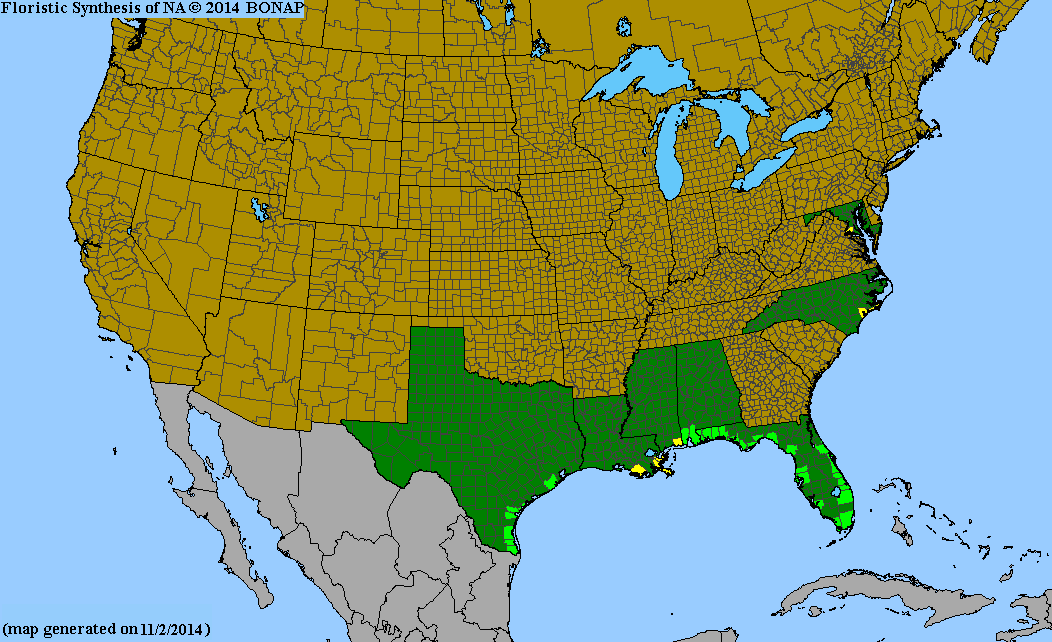
edit edit sourceThis plant is mainly found in muddy coastal marsh waters and off the coast of many Caribbean islands.[14] It has been reported from Texas,[16] Florida, Louisiana, Mississippi, Alabama, North Carolina, Maryland,[10][17] Yucatán, Quintana Roo, Tabasco,[18][19][20] Costa Rica,[21] Belize,[22] Panama, Cuba, Trinidad and Tobago, Venezuela, Brazil and Cape Verde.[23]
In California, it was intentionally introduced into the Salton Sea from Texas almost a century ago, but died out a long time ago.[24]
Ecology
edit edit sourceThese aquatic plants form sea beds and increase habitat stabilization through constant shoot and rhizome production. The string-like structure of the seagrass decrease water turbidity and movement of substrate whether it is sand or mud.[25] Seagrass beds function as an incubator for young juvenile fishes. They provide shelter from predators and reduce competition with other species. Halodule wrightii also supplies food resources to several species of fish, invertebrate marine life and manatees.[26] This species of plant has the ability to adapt to various levels of salinity and temperatures.
H. wrightii is able to reproduce sexually and asexually, however, flowering in this species is rare.
Conservation
edit edit sourceRecreational activities, like jet skiing and boating, damage and uproot seagrass beds with ease in shallow coastal waters. Studies such as the one performed in Brazil's Abrolhos Marine National Park tested the direct effects of anchor damage caused by intense boating activity, and found that H. wrightii abundance was deeply impacted.[27]
Restoration
edit edit sourceRestoration of seagrass beds has been experimentally tested many times.[28] One such experiment in Florida attempted to use H. wrightii as a pioneer species to stimulate natural succession to the eventual climax vegetation dominated by Thalassia testudinum. The experiment found that the application of fertilizer to transplants greatly increased their growth rate.[29]
References
edit edit source- ^ Short, F.T.; Carruthers, T.J.R.; van Tussenbroek, B.; Zieman, J. (2010). "Halodule wrightii". IUCN Red List of Threatened Species. 2010 e.T173372A7001725. doi:10.2305/IUCN.UK.2010-3.RLTS.T173372A7001725.en. Retrieved 12 November 2021. Wikipedia revision 1324667596, retrieved 2026-11-20
- ^ "Halodule wrightii Asch. — The Plant List". www.theplantlist.org. Wikipedia revision 1324667596, retrieved 2026-11-20
- ^ "Halodule wrightii Asch". Plants of the World Online. The Trustees of the Royal Botanic Gardens, Kew. n.d. Retrieved September 26, 2020. Wikipedia revision 1324667596, retrieved 2026-11-20
- ^ a b Godfrey, R. K. & J. W. Wooten. 1979. Aquatic and Wetland Plants of Southeastern United States Monocotyledons 1–712. The University of Georgia Press, Athens. Wikipedia revision 1324667596, retrieved 2026-11-20
- ^ "Indian River Lagoon Species Inventory". Smithsonian Marine Station at Fort Pierce. Wikipedia revision 1324667596, retrieved 2026-11-20
- ^ Berlin., Gesellschaft Naturforschender Freunde zu (1868-01-01). "Sitzungsberichte der Gesellschaft Naturforschender Freunde zu Berlin". Sitzungsberichte der Gesellschaft Naturforschender Freunde zu Berlin. 1868. ISSN 0433-8731. Wikipedia revision 1324667596, retrieved 2026-11-20
- ^ Ascherson, Paul Friedrich August. 1897. Die Natürlichen Pflanzenfamilien 2: 37. Wikipedia revision 1324667596, retrieved 2026-11-20
- ^ Hartog, Cornelis den. 1964. Blumea 12: 303. Wikipedia revision 1324667596, retrieved 2026-11-20
- ^ Hartog, Cornelis den. 1960. Pacific Naturalist 1(15): 4–5, f. 2a–c. Wikipedia revision 1324667596, retrieved 2026-11-20
- ^ a b c "Halodule wrightii in Flora of North America @ efloras.org". www.efloras.org. Retrieved 2017-02-03. Wikipedia revision 1324667596, retrieved 2026-11-20
- ^ Phillips, Ronald C. (1 July 1967). "On Species of the Seagrass, Halodule, in Florida". Bulletin of Marine Science. 17 (3): 672–676. Wikipedia revision 1324667596, retrieved 2026-11-20
- ^ McMmillan, C. 1991. Isozyme patterning in marine spermatophytes. In: L. Triest, ed. 1988+. Isozymes In Water Plants. Opera Botanica Belgica 1+ vols. Belgium, Meise. Vol. 4,: pp. 193--200. Wikipedia revision 1324667596, retrieved 2026-11-20
- ^ "Image". www.tropicos.org. Retrieved 2017-02-03. Wikipedia revision 1324667596, retrieved 2026-11-20
- ^ a b Gallegos, Me; Merino, M; Rodriguez, A; Marba, N; Duarte, Cm (1994). "Growth patterns and demography of pioneer Caribbean seagrasses Halodule wrightii and Syringodium filiforme". Marine Ecology Progress Series. 109: 99–104. Bibcode:1994MEPS..109...99G. doi:10.3354/meps109099. Wikipedia revision 1324667596, retrieved 2026-11-20
- ^ Novelo, A. & L. Ramos. 2005. Vegetación acuática. Cap. 5: 111–144. In J. Bueno, F Álvarez & S. Santiago, Biodiversidad del Estado de Tabasco. CONABIO-UNAM, México. Wikipedia revision 1324667596, retrieved 2026-11-20
- ^ Correll, D. S. & M. C. Johnston. 1970. Manual of the Vascular Plants of Texas i–xv, 1–1881. The University of Texas at Dallas, Richardson Wikipedia revision 1324667596, retrieved 2026-11-20
- ^ BONAP (Biota of North America Project) floristic synthesis, Halodule wrightii Image Wikipedia revision 1324667596, retrieved 2026-11-20
- ^ Cowan, C. P. 1983. Flora de Tabasco. Listados Florísticos de México 1: 1–123. Wikipedia revision 1324667596, retrieved 2026-11-20
- ^ Sousa Sánchez, M. & E. F. Cabrera Cano. 1983. Flora de Quintana Roo. Listados Florísticos de México 2: 1–100. Wikipedia revision 1324667596, retrieved 2026-11-20
- ^ Novelo R., A. & A. L. H. 1994. 239. Cymodoceaeceae. 6: 15–16. In G. Davidse, M. Sousa Sánchez & A.O. Chater (eds.) Flora Mesoamericana. Universidad Nacional Autónoma de México, México, D. F. Wikipedia revision 1324667596, retrieved 2026-11-20
- ^ Hammel, B. E. 2003. Cymodoceaceae. In: Manual de Plantas de Costa Rica, B.E. Hammel, M.H. Grayum, C. Herrera & N. Zamora (eds.). Monographs in systematic botany from the Missouri Botanical Garden 92: 456–457. Wikipedia revision 1324667596, retrieved 2026-11-20
- ^ Balick, M. J., M. H. Nee & D.E. Atha. 2000. Checklist of the vascular plants of Belize. Memoirs of The New York Botanical Garden 85: i–ix, 1–246. Wikipedia revision 1324667596, retrieved 2026-11-20
- ^ Creed, Joel C.; Engelen, Aschwin H.; D´Oliveira, Emanuel C.; Bandeira, Salomão; Serrão, Ester A. (December 2016). "First record of seagrass in Cape Verde, eastern Atlantic". Marine Biodiversity Records. 9 (1): 57. doi:10.1186/s41200-016-0067-9. S2CID 7494405. Wikipedia revision 1324667596, retrieved 2026-11-20
- ^ Hickman, J. C. 1993. The Jepson Manual: Higher Plants of California 1–1400. University of California Press, Berkeley. Wikipedia revision 1324667596, retrieved 2026-11-20
- ^ Hall, Lauren M.; Hanisak, M. Dennis; Virnstein, Robert W. (3 April 2006). "Fragments of the seagrasses Halodule wrightii and Halophila johnsonii as potential recruits in Indian River Lagoon, Florida". Marine Ecology Progress Series. 310: 109–117. Bibcode:2006MEPS..310..109H. doi:10.3354/meps310109. JSTOR 24870011. Wikipedia revision 1324667596, retrieved 2026-11-20
- ^ Pereira, Pedro H.C.; Ferreira, Beatrice P.; Rezende, Sérgio M. (September 2010). "Community structure of the ichthyofauna associated with seagrass beds (Halodule wrightii) in Formoso River estuary - Pernambuco, Brazil". Anais da Academia Brasileira de Ciências. 82 (3): 617–628. doi:10.1590/S0001-37652010000300009. PMID 21562690. Wikipedia revision 1324667596, retrieved 2026-11-20
- ^ Creed, Joel C; Amado Filho, Gilberto M (March 1999). "Disturbance and recovery of the macroflora of a seagrass (Halodule wrightii Ascherson) meadow in the Abrolhos Marine National Park, Brazil: an experimental evaluation of anchor damage". Journal of Experimental Marine Biology and Ecology. 235 (2): 285–306. doi:10.1016/S0022-0981(98)00188-9. Wikipedia revision 1324667596, retrieved 2026-11-20
- ^ van Katwijk, Marieke M.; Thorhaug, Anitra; Marbà, Núria; Orth, Robert J.; Duarte, Carlos M.; Kendrick, Gary A.; Althuizen, Inge H. J.; Balestri, Elena; Bernard, Guillaume; Cambridge, Marion L.; Cunha, Alexandra; Durance, Cynthia; Giesen, Wim; Han, Qiuying; Hosokawa, Shinya; Kiswara, Wawan; Komatsu, Teruhisa; Lardicci, Claudio; Lee, Kun-Seop; Meinesz, Alexandre; Nakaoka, Masahiro; O'Brien, Katherine R.; Paling, Erik I.; Pickerell, Chris; Ransijn, Aryan M. A.; Verduin, Jennifer J. (April 2016). "Global analysis of seagrass restoration: the importance of large-scale planting". Journal of Applied Ecology. 53 (2): 567–578. doi:10.1111/1365-2664.12562. hdl:11568/759969. Wikipedia revision 1324667596, retrieved 2026-11-20
- ^ Kenworthy, W. Judson; Hall, Margaret O.; Hammerstrom, Kamille K.; Merello, Manuel; Schwartzschild, Arthur (March 2018). "Restoration of tropical seagrass beds using wild bird fertilization and sediment regrading". Ecological Engineering. 112: 72–81. doi:10.1016/j.ecoleng.2017.12.008. Wikipedia revision 1324667596, retrieved 2026-11-20
- Wikidata: Q5643366
- Wikispecies: Halodule wrightii
- AlgaeBase: 21537
- AoFP: 612
- APA: 3862
- APDB: 39381
- APNI: 116627
- BOLD: 411529
- Calflora: 4000
- CoL: 6KZYS
- CNPS: 2829
- EoL: 1088906
- FNA: 222000075
- GBIF (old): 2864094
- GRIN: 415379
- iNaturalist: 133336
- IPNI: 602957-1
- IRMNG: 10933435
- ITIS: 514405
- IUCN: 173372
- NatureServe: 2.128968
- NCBI: 13078
- OBIS: 208925
- Open Tree of Life: 87589
- Paleobiology Database: 214625
- Plant List: kew-308065
- PLANTS: HAWR
- POWO: urn:lsid:ipni.org:names:602957-1
- SeaLifeBase: 141717
- Tropicos: 26300075
- WFO: wfo-0000769317
- WoRMS: 208925
Text derived from https://en.wikipedia.org/w/index.php?oldid=1324667596 under CC BY-SA 4.0; modifications have been made.