Hulsea algida
Hulsea algida is a species of flowering plant in the daisy family, known by the common name Pacific hulsea or alpine gold.
≈ 2 min read
Names in other languages
No names in other languages are held for this entry yet.
Article bodies are English and are not machine-translated. A name in another language is not a translation of the article.
Hulsea algida is a species of flowering plant in the daisy family, known by the common name Pacific hulsea or alpine gold. It is native to the western United States.
Description
H. algida is a hairy, glandular perennial herb producing stout erect stems approaching 40 centimeters (16 inches) in height. The dark green leaves are narrow and covered in white hairs, and the edges are wavy and toothed. Most of the leaves occur in a thick patch at the base of the plant, where they can reach in length, and some grow from the stems.
Appearing from July to September, the pseudanthium (flower head) is encased in a cup of densely woolly reddish green phyllaries which open to reveal a daisy-like bloom wide. The center of the head is filled with yellow or orange disc florets and the circumference has up to 60 bright yellow or gold ray florets each about 1 cm long with rounded or toothed tips.
The fruit is an achene up to 1 cm long with a pappus which may be longer. H. nana is similar, but rarely more than tall, with a leafless stalk and 21 ray flowers per pseudanthium.
Distribution and habitat
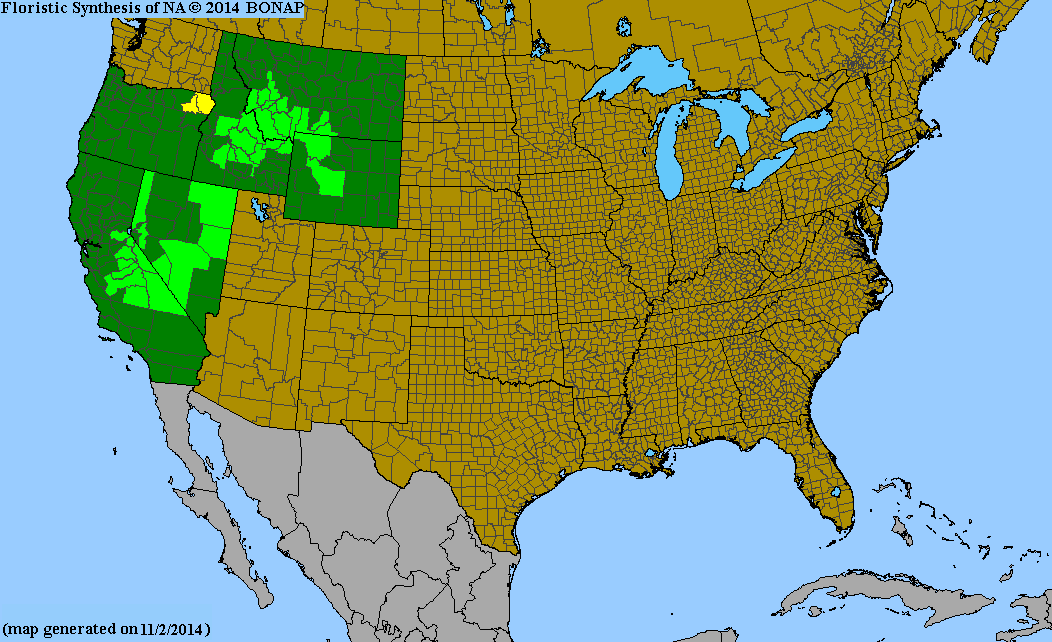
The species is native to California, Oregon, Nevada, Idaho, Montana, and Wyoming. Within California, it grows in the Sierra Nevada and in the White Mountains. It grows between in elevation, in alpine and subalpine talus habitats.
External links
Jepson Manual Treatment — Hulsea algida United States department of Agriculture Plants Profile: Hulsea algida (alpine gold) Hulsea algida — Calphotos Photo gallery, University of California
Text derived from https://en.wikipedia.org/w/index.php?oldid=1329747691 under CC BY-SA 4.0; modifications have been made.