Hurricane David
Hurricane David was a devastating tropical cyclone that struck Dominica and the Dominican Republic in August 1979, causing widespread destruction and numerous fatalities.
≈ 11 min read
Names in other languages
No names in other languages are held for this entry yet.
Article bodies are English and are not machine-translated. A name in another language is not a translation of the article.
Hurricane David was a devastating tropical cyclone that struck Dominica and the Dominican Republic in August 1979, causing widespread destruction and numerous fatalities. It remains the most intense hurricane to make landfall in the Dominican Republic’s recorded history.
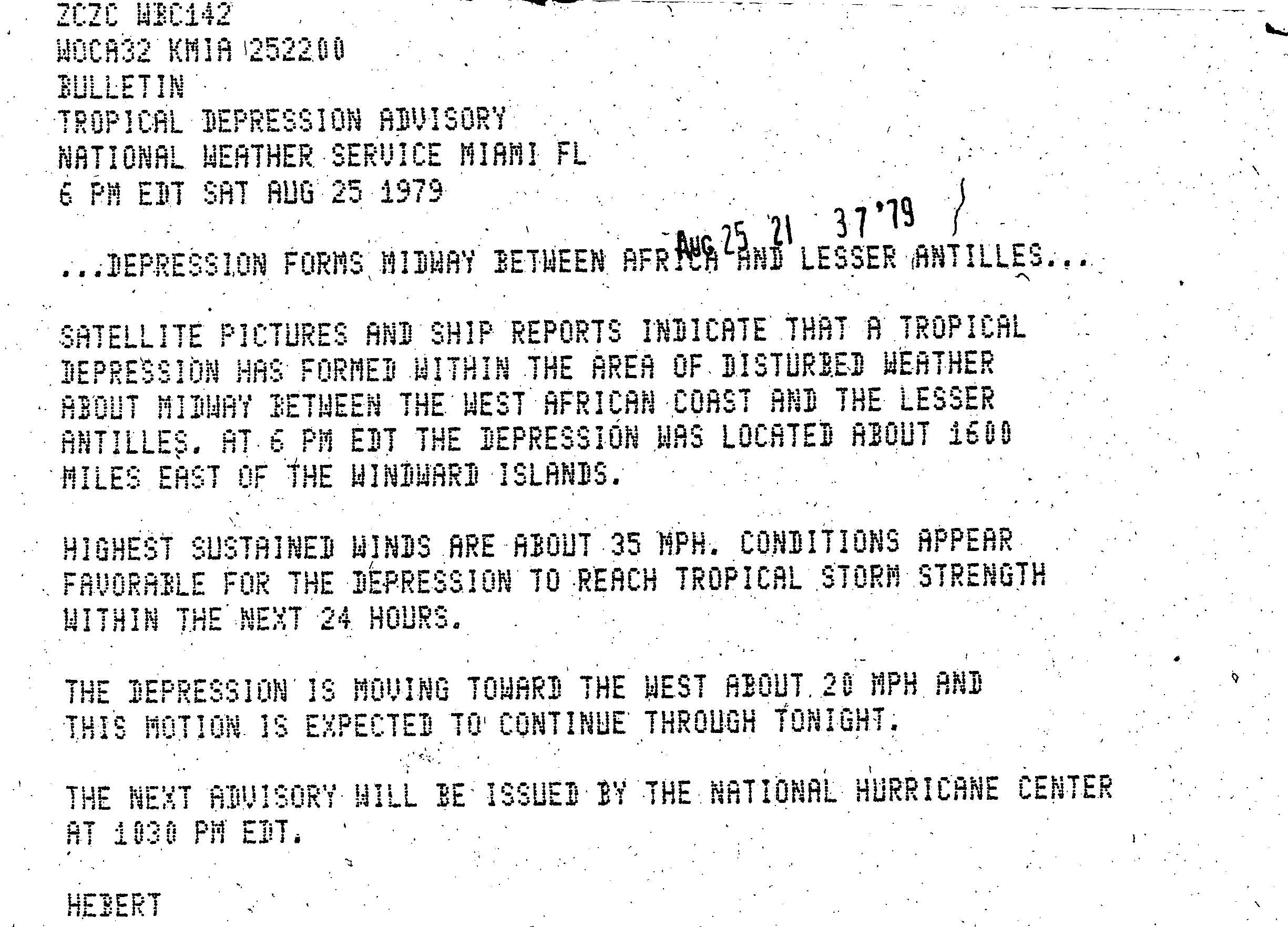
A long-lived Cape Verde hurricane, David was the fourth named storm, second hurricane, and first major hurricane of the 1979 Atlantic hurricane season. David formed on August 25, in the eastern tropical Atlantic Ocean near Cape Verde off the coast of West Africa.
Two days later, the storm reached hurricane strength, then underwent rapid intensification, strengthening into a Category 5 hurricane and reaching peak sustained winds of on August 28. By the time the system dissipated on September 8, it had traversed the Leeward Islands, Greater Antilles, The Bahamas, the East Coast of the United States, and Atlantic Canada.
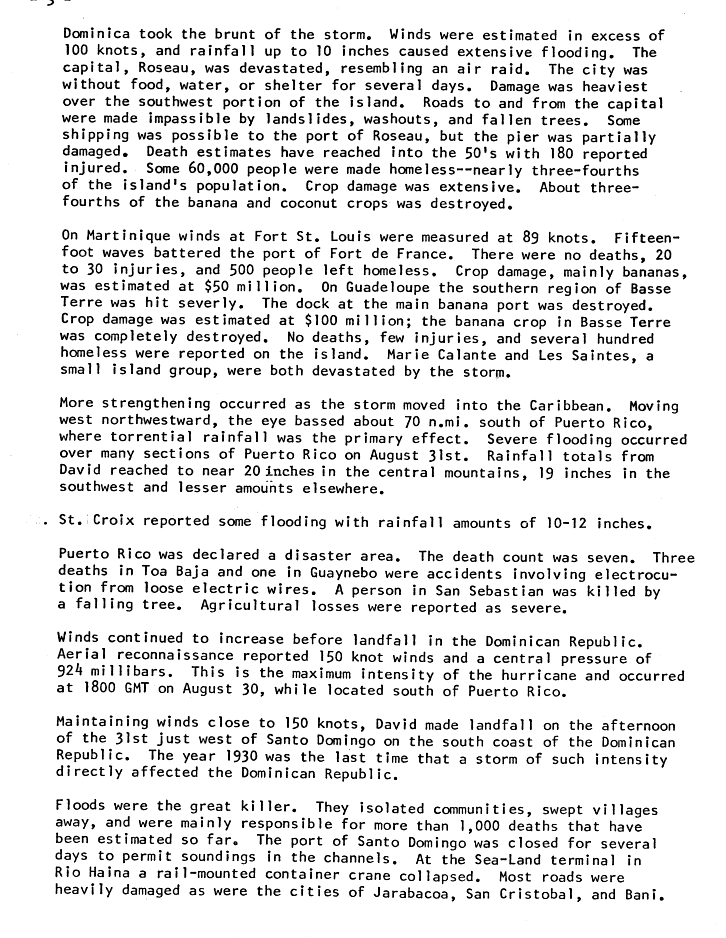
David was the first hurricane to affect the Lesser Antilles since Hurricane Inez in 1966 and the deadliest to hit Dominica since the 1834 Padre Ruíz hurricane, which killed over 200 people. There, strong winds from David damaged or destroyed 80% of homes, leaving 75% of the island's population homeless.
Agriculture was also severely impacted, with 75% of crops ruined, including a complete loss of bananas. David killed 56 people and injured 180 others on Dominica.…
Hurricane David was a devastating tropical cyclone that struck Dominica and the Dominican Republic in August 1979, causing widespread destruction and numerous fatalities. It remains the most intense hurricane to make landfall in the Dominican Republic’s recorded history.
A long-lived Cape Verde hurricane, David was the fourth named storm, second hurricane, and first major hurricane of the 1979 Atlantic hurricane season. David formed on August 25, in the eastern tropical Atlantic Ocean near Cape Verde off the coast of West Africa.
Two days later, the storm reached hurricane strength, then underwent rapid intensification, strengthening into a Category 5 hurricane and reaching peak sustained winds of on August 28. By the time the system dissipated on September 8, it had traversed the Leeward Islands, Greater Antilles, The Bahamas, the East Coast of the United States, and Atlantic Canada.
David was the first hurricane to affect the Lesser Antilles since Hurricane Inez in 1966 and the deadliest to hit Dominica since the 1834 Padre Ruíz hurricane, which killed over 200 people. There, strong winds from David damaged or destroyed 80% of homes, leaving 75% of the island's population homeless.
Agriculture was also severely impacted, with 75% of crops ruined, including a complete loss of bananas. David killed 56 people and injured 180 others on Dominica. In addition, similar destruction occurred on Guadeloupe and Martinique, with hundreds left homeless and extensive damage to crops.
Guadeloupe and Martinique also had $50 million and $100 million in damage, respectively. In Puerto Rico, flooding and high winds combined resulted in $70 million in damage and seven fatalities, four from electrocution.
With winds of , David was one of only two storms of Category 5 intensity to strike the Dominican Republic in the 20th century, the other also being Inez, and the deadliest since the 1930 San Zenón hurricane, killing over 2,000 people in its path. Entire villages were destroyed and numerous others were left isolated because of damage or destruction to many roads.
Thousands of houses were destroyed, leaving over 200,000 homeless in the aftermath of the hurricane. Additionally, nearly 70% of the country's crops were ruined. Minimal impact occurred in the Bahamas, Cuba, and Haiti.
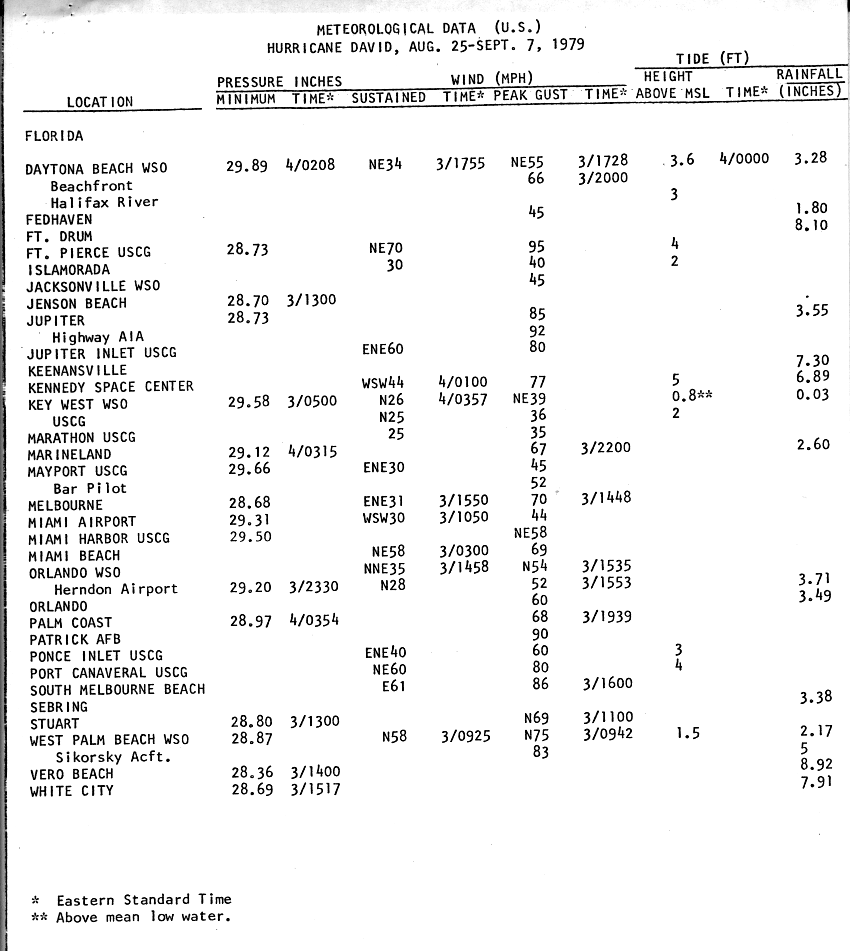
In Florida, strong winds left moderate damage, including a downed radio tower, snapping a crane, and deroofing buildings. There were also 10 tornadoes. Damage totaled approximately $95 million.
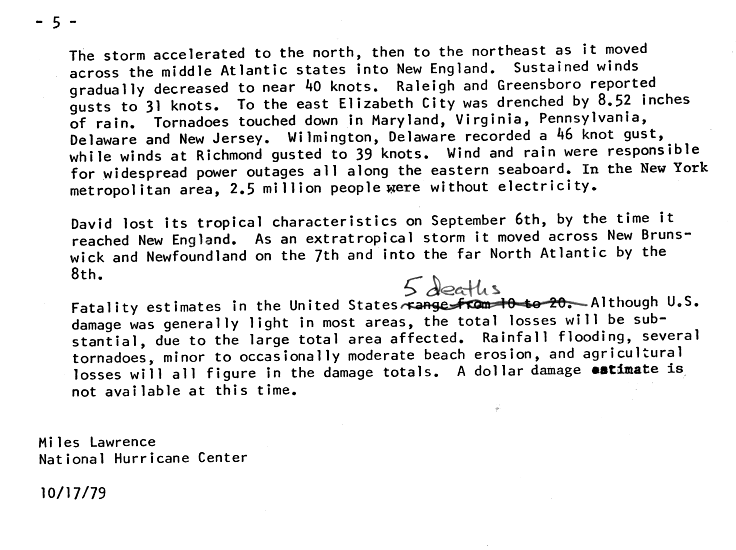
Other states along the East Coast of the United States experienced flooding and tornadoes. The latter was particularly severe in Virginia, with tornadoes causing one death, damaging 270 homes, and destroying three other homes. Throughout the United States, there were 15 deaths and about $320 million in damage.
Preparations
In the days prior to hitting Dominica, David was originally expected to hit Barbados and spare Dominica in the process. However, on August 29, a turn in the hours before moving through the area caused the hurricane to make a direct hit on the southern part of Dominica.
Even as it became increasingly clear that David was headed for the island, residents did not appear to take the situation seriously. This can be partly attributed to the fact that local radio warnings were minimal and disaster preparedness schemes were essentially non-existent.
Furthermore, Dominica had not experienced a major hurricane since 1930, thus leading to complacency among much of the population. This proved to have disastrous consequences for the island nation.
Some 400,000 people evacuated in the United States in anticipation of David, including 300,000 people in southeastern Florida due to a predicted landfall between the Florida Keys and Palm Beach. Of those, 78,000 fled to shelters, while others either stayed at a friend's house further inland or traveled northward.
Making landfall during Labor Day weekend, David forced the cancellations of many activities in the greater Miami area. After Labor Day, schools were closed in several counties on September 4: Baker, Brevard, Clay, Duval, Flagler, Hendry, Indian River, Martin, Monroe, Nassau, Okeechobee, Orange, Osceola, Palm Beach, Putnam, Seminole, St. Johns, and Volusia.
Dominica
Immediately after the storm, lack of power prevented communications and the outside world had little knowledge of the extent of the damage in Dominica. A citizen named Fred White ended that by using a battery-operated ham radio to contact the world. personnel unloading relief aid from a helicopter in Dominica]] In response to the severe agricultural damage, the government initiated a food ration.
By two months after the storm, assistance pledges amounted to over $37 million from various groups around the world. Similar to the aftermath of other natural disasters, the distribution of the aid raised concerns and accusations over the amount of food and material, or lack thereof, for the affected citizens.
The hurricane destroyed some important landmarks, including a significant part of the ruins of the Fort Young which had stood since the 1770s. Looting was practiced in supermarkets, seaports, and homes; what was not destroyed by the hurricanes was stolen in the weeks after the storm. The destroyer was on its way back to the United Kingdom when the hurricane struck, and was turned back to provide emergency aid to the island.
Sailing through mountainous seas, Fife docked in the main harbor at Roseau without assistance, and was the only outside help for several days. The crew provided work details and medical parties to offer assistance to the island and concentrated on the hospital buildings, the airstrip, and restoring power and water.
The ship's helicopter (called Humphrey) took medical aid into the hills to assist people who were cut off from getting to other help by fallen trees. The ship also used its radio systems to broadcast news and music to the island to inform the population of what was being done and how to get assistance.
This was the first time a Royal Navy ship had provided a public broadcast news service.
Dominican Republic
Immediately following the storm, more than 200,000 people left homeless sought refuge at churches and public buildings. Tropical Storm Frederic struck the Dominican Republic only about a week after David, exacerbating recovery efforts.
In September 1979, the Civil Defense Secretariat of the Dominican Republic provided assistance to approximately 1.8 million people via international organizations such as Care International (CARE), the Catholic Relief Services (CRS), the Church World Service (CWS), and the Peace Corps. Prior to David, these organizations had staged over of P.L. 480 food commodities, which suffered little damage from the storm.
CARE and CRS distributed an additional of P.L. 480 food commodities between October 1979 and September 1980. The Civil Defense Secretariat also ordered nearly all privately owned construction equipment be used to clear blocked roadways. Approximately 500,000 sheets galvanized roofing, manufactured locally, was purchased by the government of the Dominican Republic.
Within two months, the National Housing Institute and private firms repaired over 12,000 homes. The Secretariat of Agriculture provided assistance with replanting 60–90-day crops. Businesses, non-governmental organizations, and volunteers within the Dominican Republic also contributed significantly, providing construction materials and bedding, clothing, and shoes.
Thousands of family-sized food parcels were packed by volunteered and shipped to devastated areas. The United Nations and intergovernmental organizations, including the European Economic Community, Food and Agriculture Organization, Inter-American Development Bank, Organization of American States, Pan American Health Organization, United Nations Development Programme, United Nations Office for the Coordination of Humanitarian Affairs, United Nations Children's Fund, World Food Programme, and World Bank, provided more than $139.2 million in material and monetary donations.
Cash donations and relief supplies were contributed from Red Cross agencies throughout the world, including from Australia, the Bahamas, Belgium, Canada, Chile, Colombia, Denmark, Finland, Germany, Honduras, Hungary, Italy, Japan, Monaco, New Zealand, Norway, Romania, Spain, Sweden, Switzerland, Thailand, the United Kingdom, the United States, and Yugoslavia. Additionally France's Médecins Sans Frontières and Action d'urgence internationale and the United Kingdom's Oxfam also provided money and supplies.
Overall, contributions from these non-governmental organizations totaled nearly $203.13 million. The United States Congress and president Jimmy Carter approved legislation appropriating $15 million in aid to the Dominican Republic. By 1980, the United States government contributed funds and materials with a monetary value totaling just over $10.1 million.
Aside from CARE, CRS, and CWS, non-governmental organizations based in the United States with significant donations of funds and supplies were the American Institute for Free Labor Development, Assemblies of God, Baptist World Alliance, Brother's Brother Foundation, Catholic Medical Mission Board, Compassion International, Direct Relief, Lutheran World Relief, MAP International, Michigan Partners of the Americas, Missionary Enterprises, Redemptorists (Baltimore Province), Roman Catholic Episcopate of Puerto Rico, Salesians of St. John Bosco, Salvation Army, Save the Children USA, Seventh-day Adventist World Service, Sister Cities International, Southern Baptist Convention, World Relief, and World Vision International. These organizations combined gave over $2.5 million in aid.
Other national governments contributing aid included Argentina, Austria, Canada, Colombia, Cuba, El Salvador, France, Germany, Haiti, Japan, Liechtenstein, Netherlands, Norway, Sweden, Switzerland, Taiwan, the United Kingdom, and Venezuela.
United States
Despite the casualties and damages attributed to David, the storm's effects were not as bad as in other countries. In particular, South Florida escaped relatively lightly. Because of this, then NHC Director Neil Frank was accused of overly stirring up panic before the arrival of David.
Two local psychiatrists even claimed that the experience would make residents more complacent towards future storms. However, the NHC defended their methods, with Frank stating: "If we hadn't [raised public alarm] and our predictions had been more accurate, the consequences would have been disastrous."
One reporter who covered Hurricane David was Dick Baumbach, a journalist with TODAY newspaper, now known as Florida Today. He along with news photographer Scott Maclay followed the path of the hurricane from Miami to Central Florida. In Cocoa Beach, Baumbach decided to ride out the hurricane in his home with two other journalists.
While it was a difficult and trying experience, all three reporters survived and ended up winning numerous awards. The hurricane also interrupted the filming of the movie Caddyshack that was taking place at the Rolling Hills Country Club in Fort Lauderdale.
Retirement
The name David was retired following this storm because of its devastation and high death toll; it will never be used again to name a tropical system in the North Atlantic. It was replaced with Danny for the 1985 season.
See also
List of Category 5 Atlantic hurricanes
External links
Radar loop of Hurricane David Satellite loop of David, Elena, Frederic, and Gloria Hurricane David Rainfall – HPC Hurricane David damage (archived April 26, 2006) Remembering Hurricane David CHC Storms 1979 (archived February 10, 2006) PalmBeachPost.com (Hurricane David)
Text derived from https://en.wikipedia.org/w/index.php?oldid=1375529024 under CC BY-SA 4.0; modifications have been made.