Ice spike
≈ 4 min read
Names in other languages
No names in other languages are held for this entry yet.
Article bodies are English and are not machine-translated. A name in another language is not a translation of the article.
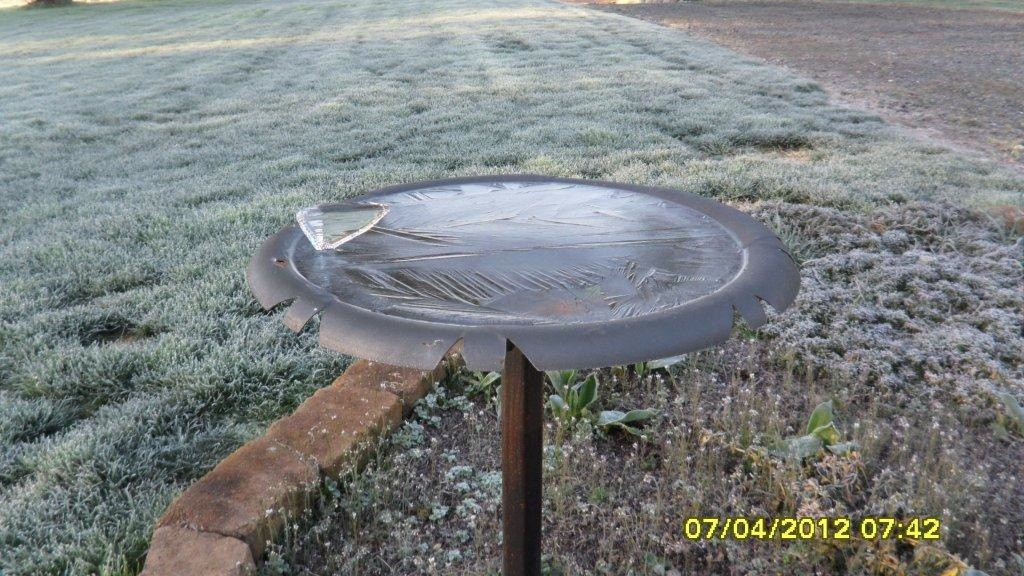
An ice spike is an ice formation, often in the shape of an inverted icicle, that projects upwards from the surface of a body of frozen water. Ice spikes created by natural processes on the surface of small bodies of frozen water have been reported for many decades, although their occurrence is quite rare.
How it works
A mechanism for their formation, now known as the Bally–Dorsey model, was proposed in the early 20th century but this was not tested in the laboratory for many years. , a number of photographs of natural ice spikes have appeared on the Internet as well as methods of producing them artificially by freezing distilled water in domestic refrigerators or freezers.
This has allowed a small number of scientists to test the hypothesis in a laboratory setting and, although the experiments appear to confirm the validity of the Bally–Dorsey model, they have raised further questions about how natural ice spikes form, and more work remains to be done before the phenomenon is fully understood. Natural ice spikes can grow into shapes other than a classic spike shape, and have been variously reported as ice candles, ice towers or ice vases as there is no standard nomenclature for these other forms.
One particularly unusual form takes the shape of an inverted pyramid.…
An ice spike is an ice formation, often in the shape of an inverted icicle, that projects upwards from the surface of a body of frozen water. Ice spikes created by natural processes on the surface of small bodies of frozen water have been reported for many decades, although their occurrence is quite rare.
A mechanism for their formation, now known as the Bally–Dorsey model, was proposed in the early 20th century but this was not tested in the laboratory for many years. , a number of photographs of natural ice spikes have appeared on the Internet as well as methods of producing them artificially by freezing distilled water in domestic refrigerators or freezers.
This has allowed a small number of scientists to test the hypothesis in a laboratory setting and, although the experiments appear to confirm the validity of the Bally–Dorsey model, they have raised further questions about how natural ice spikes form, and more work remains to be done before the phenomenon is fully understood. Natural ice spikes can grow into shapes other than a classic spike shape, and have been variously reported as ice candles, ice towers or ice vases as there is no standard nomenclature for these other forms.
One particularly unusual form takes the shape of an inverted pyramid. Although natural ice spikes are usually measured in centimeters or inches, a report that appeared in the Harbor Creek Historical Society Newsletter by Canadian Gene Heuser, who hiked across frozen Lake Erie in 1963, spoke of "small pinholes in the ice through which the water below was periodically forced under pressure to spout up into the air and freeze" producing "frozen spurts that looked to him like telephone poles standing straight up all over the lake".
Text derived from https://en.wikipedia.org/w/index.php?oldid=1369432308 under CC BY-SA 4.0; modifications have been made.