Kedesh
≈ 9 min read
Names in other languages
No names in other languages are held for this entry yet.
Article bodies are English and are not machine-translated. A name in another language is not a translation of the article.
Kedesh (alternate spellings: Qedesh, Cadesh, Cydessa) was an ancient Canaanite and later Israelite settlement in Upper Galilee, mentioned several times in the Hebrew Bible. Its remains are located in Tel Kedesh, northeast of the modern Kibbutz Malkiya in Israel on the Israeli-Lebanese border. The settlement is first documented in the Book of Joshua as a Canaanite citadel conquered by the Israelites and designated as a Levitical city and City of Refuge. Jewish tradition holds that Deborah, Barak and Jael were buried near Kedesh. In the 8th century BCE, it was captured by Tiglath-Pileser III of Assyria and its inhabitants deported. During the 5th century BCE, it possibly became the capital of the Achaemenid province of Upper Galilee. In the Hellenistic period, Kedesh was the site of battles involving Jonathan Apphus and Seleucid king Demetrius II. In the Roman period, Josephus records Jewish attacks on Kedesh during the First Jewish–Roman War, with Titus establishing a camp there. The site was later mentioned in Eusebius. Excavations from 1997 to 2012 revealed significant Persian and Hellenistic administrative buildings and a large Roman temple complex. As Qadas (also Cadasa; ), it was a Palestinian village located 17 kilometers northeast of Safad that was depopulated during the 1947–19491 Palestine war.…
Kedesh (alternate spellings: Qedesh, Cadesh, Cydessa) was an ancient Canaanite and later Israelite settlement in Upper Galilee, mentioned several times in the Hebrew Bible. Its remains are located in Tel Kedesh, northeast of the modern Kibbutz Malkiya in Israel on the Israeli-Lebanese border. The settlement is first documented in the Book of Joshua as a Canaanite citadel conquered by the Israelites and designated as a Levitical city and City of Refuge. Jewish tradition holds that Deborah, Barak and Jael were buried near Kedesh. In the 8th century BCE, it was captured by Tiglath-Pileser III of Assyria and its inhabitants deported. During the 5th century BCE, it possibly became the capital of the Achaemenid province of Upper Galilee. In the Hellenistic period, Kedesh was the site of battles involving Jonathan Apphus and Seleucid king Demetrius II. In the Roman period, Josephus records Jewish attacks on Kedesh during the First Jewish–Roman War, with Titus establishing a camp there. The site was later mentioned in Eusebius. Excavations from 1997 to 2012 revealed significant Persian and Hellenistic administrative buildings and a large Roman temple complex. As Qadas (also Cadasa; ), it was a Palestinian village located 17 kilometers northeast of Safad that was depopulated during the 1947–1949 Palestine war. One of seven villages populated by Shia Muslims, called the Metawalis, that fell within the boundaries of British Mandate Palestine, Qadas is today known as the tell of the ancient biblical city of Kedesh. The village of Qadas contained many natural springs which served as the village water supply and a Roman temple dating back to the 2nd century.
History
Kedesh of Naphtali
Identification of the biblical "Kedesh of Naphtali" (Judges 4:6, 10) has been the subject of archaeological and historical debate. While many hold the ancient site to be in Upper Galilee, near the Lebanese border, Israeli archaeologist, Yohanan Aharoni, held the view that it lay in Lower Galilee, near the Valley of Jezreel, at a site which bears the same name (now Khirbet Qadish). Some prominent archaeological publications have, therefore, listed the site as being east of the "Jabneel valley" in "Lower Galilee".
Excavation project at Tel Kedesh
From 1997–2012, archaeological excavations were conducted at the Tel Kedesh site by Sharon Herbert and Andrea Berlin on behalf of the University of Michigan. The excavations revealed an enormous Persian-Hellenistic administrative building built in the later sixth century BC. Over the next 350 years, this complex provided a stage for interactions between imperial powers, provincial administrators and local elites – as control shifted from the Achaemenid Persians, to the Ptolemies of Egypt, and then the Seleucids of Syria.
Middle Ages
Under the rule of the Islamic Abbasid Caliphate in the 10th century CE, Qadas was a town in Jund al-Urrdun ("District of Jordan"). According to al-Muqaddasi in 985, "Qadas was a small town on the slope of the mountain. It is 'full of good things'. Jabal Amilah is the district which is in its neighborhood. The town possesses three springs from which the people drink, and they have a bath below the city. The mosque is in the market, and in its court is a palm tree. The climate of this place is very hot. Near Qadas is the (Hulah) Lake." Ishtori Haparchi, visiting the holy sites in the early fourteenth-century wrote of Kedesh: "About half a day's distance southward of Paneas, known in Arabic as Banias, is Kedesh, in the mountain of Naphtali, and it is [now] called Qades."
Ottoman era
In 1517, Palestine was incorporated into the Ottoman Empire and in the 1596 tax records, the village appeared as Qadas, under the nahiya ("subdistrict") of Tibnin, under Sanjak Safad, with a population of 49 households and 9 bachelors, (an estimated population of 319 people1), all Muslim. They paid a fixed tax-rate of 25% on various agricultural products, such as wheat, barley, olives, cotton, orchards, beehives, and goats, as well as a press that processed either grapes or olives; a total of 10,472 akçe. Victor Guérin visited in 1875, and noted: "The village of this name, which has at most 300 inhabitants1, occupies barely a third of a beautiful hill, formerly entirely covered with dwellings and surrounded by a wall built of dressed stones, of which only a few levelling are now visible. The houses of the village almost all contain ancient fragments from toppled buildings. In one, among others, I am shown, on a column, a sculpted head representing the figure of the sun with a crown of rays". In 1881, the PEF's Survey of Western Palestine (SWP), Qadas was described as a stone-built village, situated on a spur of a ridge. The population, which was estimated to be between 100 and 300, cultivated fig and olive trees. SWP also noted that the "Metawali" from Qadas went to nearby Al-Nabi Yusha' to venerate the name of Joshua.
British Mandate era
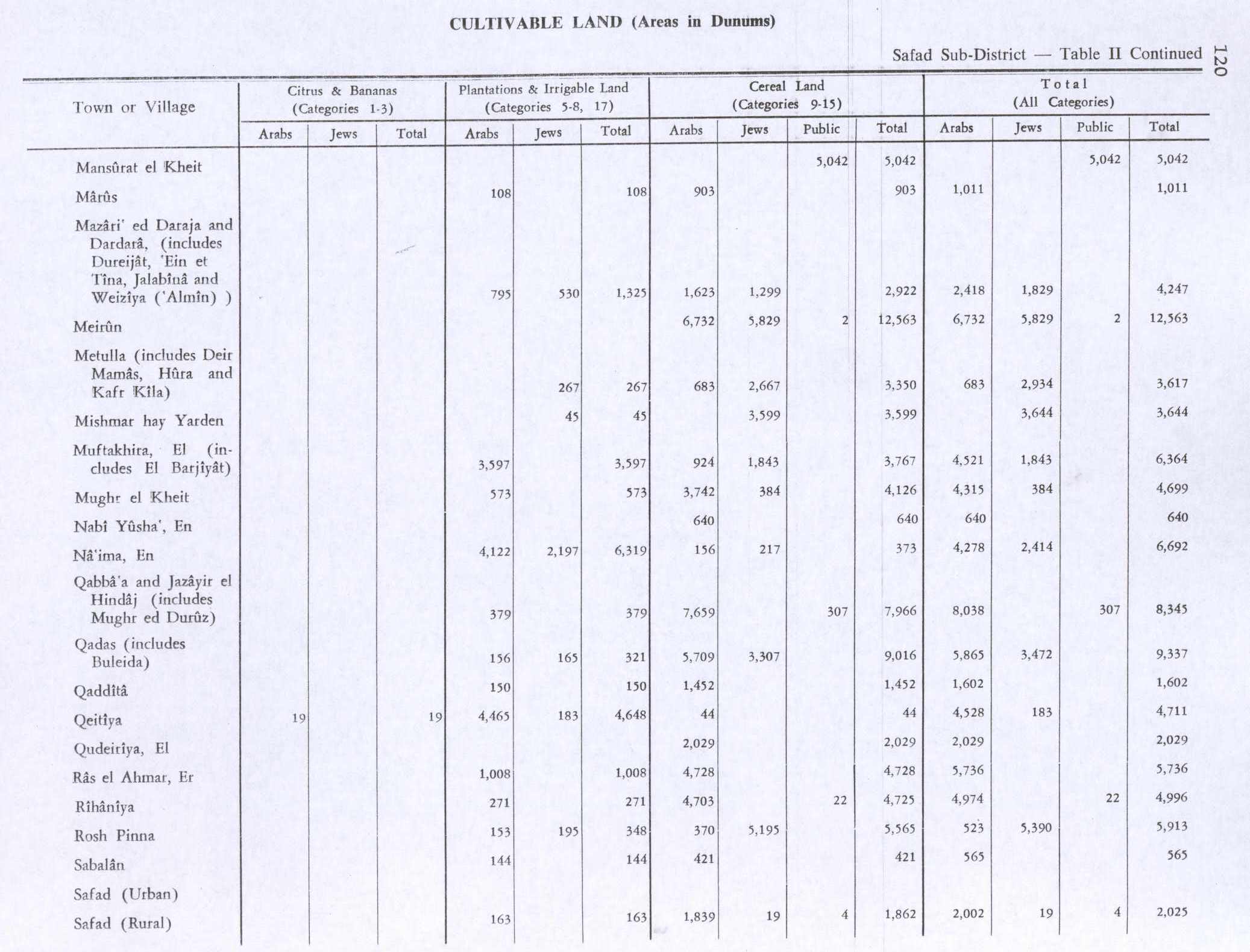
Qadas was a part of the French-controlled Lebanon until 1923, when the British Mandate of Palestine's borders were delineated to include it. Rainfall and the abundance of springs allowed the village to develop a prosperous agricultural economy based on grain, fruit, and olives. In the 1931 census of Palestine, conducted by the British Mandate authorities, Qadas had a population of 273; 1 Christian and 272 Muslims, in a total of 56 houses. In the 1945 statistics the village had a total of 5,709 dunums of land allotted to cereals, while 156 dunums were irrigated or used for orchards.
1948 war, and aftermath
Qadas was occupied by Israeli forces during Operation Yiftach on 28 May 1948. Defended by the Arab Liberation Army and the Lebanese army, its inhabitants fled under the influence of the fall of, or exodus from, neighbouring towns. In June, 1948, kibbutz Manara requested land from the newly depopulated village of Qadas, as it was "suitable for winter crops". The settlement of Yiftach was built in 1948 to the northeast of the village site on lands belonging to Qadas. The village land is also used by the settlements of Malkiyya, founded in 1949, and Ramot Naftali, established in 1945. Walid Khalidi described the remaining structures of the former village in 1992 as follows: Stones from the destroyed houses are strewn over the fenced-in site, and a few partially destroyed walls near the spring are visible. The flat portions of the surrounding lands are planted with apple trees; the spring provides drinking water for cattle. Hassan Nasrallah, the secretary-general of Hezbollah, has publicly recalled on occasion the fate of Qadas and the other Metawali villages in his references to the 1948 annexation of several Lebanese villages, the expulsion of their residents, the expropriation of their property and the destruction of their homes. As of 2023, an archaeological project was underway to investigate the recent history of Qadas before its destruction. Team leader Raphael Greenberg noted that his project was unusual in its focus on Palestinian remains, contrary to the usual practice of digging around or through them to reach what is beneath.
See also
Al-Malkiyya Shia villages in Palestine
Bibliography
(SWP I, pp. 226-227) (p. 70)
External links
Photos of the ruins at Tel Kedesh from the Manar al-Athar photo archive Welcome the Qadas Qadas, Zochrot Survey of Western Palestine, Map 4: IAA, SWP Wikimedia commons Qadas, from the Khalil Sakakini Cultural Center Villages of Palestine - Qadas, Dr. Khalil Rizk Andrea Berlin: One Site, Two Peoples: Phoenicians and Jews at Kedesh of the Upper Galilee, Anglo-Israel Archaeological Society, 13 June 2023
Text derived from https://en.wikipedia.org/w/index.php?oldid=1378261966 under CC BY-SA 4.0; modifications have been made.