Kurdistan
≈ 6 min read
Names in other languages
No names in other languages are held for this entry yet.
Article bodies are English and are not machine-translated. A name in another language is not a translation of the article.
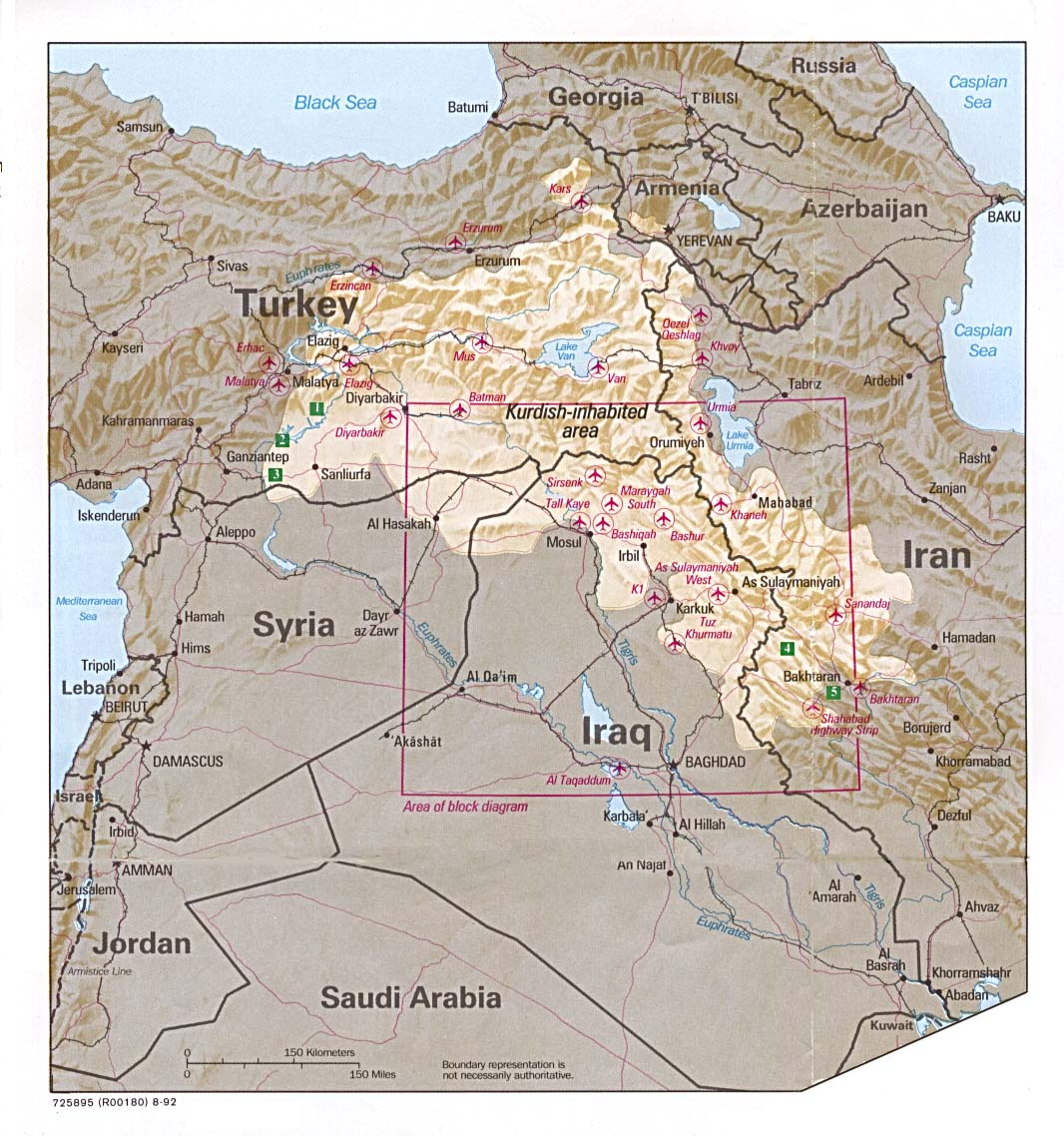
Kurdistan ( ; ), or Greater Kurdistan, is a roughly defined geo-cultural region and stateless nation in West Asia wherein the Kurds form a prominent majority population and the Kurdish culture, languages, and national identity have historically been based. Geographically, Kurdistan roughly encompasses the northwestern Zagros and the eastern Taurus mountain ranges.
Kurdistan generally comprised the following four regions: southeastern Turkey (Northern Kurdistan), northern Iraq (Southern Kurdistan), northwestern Iran (Eastern Kurdistan), and northern Syria (Western Kurdistan). Some definitions also include parts of southern Transcaucasia.
Certain Kurdish nationalist organizations seek to create an independent nation state consisting of some or all of these areas with a Kurdish majority, while others campaign for greater autonomy within the existing national boundaries. The delineation of the region remains disputed and varied, with some maps greatly exaggerating its boundaries.
Historically, the word "Kurdistan" is first attested in 11th century Seljuk chronicles. Many disparate Kurdish dynasties, emirates, principalities, and chiefdoms were established from the 8th to 19th centuries. Administratively, the 20th century saw the establishment of the short-lived areas of the Kurdish state (1918–1919), Kingdom of Kurdistan (1921–1924), Kurdistansky Uyezd i.e.…
Kurdistan ( ; ), or Greater Kurdistan, is a roughly defined geo-cultural region and stateless nation in West Asia wherein the Kurds form a prominent majority population and the Kurdish culture, languages, and national identity have historically been based. Geographically, Kurdistan roughly encompasses the northwestern Zagros and the eastern Taurus mountain ranges.
Kurdistan generally comprised the following four regions: southeastern Turkey (Northern Kurdistan), northern Iraq (Southern Kurdistan), northwestern Iran (Eastern Kurdistan), and northern Syria (Western Kurdistan). Some definitions also include parts of southern Transcaucasia.
Certain Kurdish nationalist organizations seek to create an independent nation state consisting of some or all of these areas with a Kurdish majority, while others campaign for greater autonomy within the existing national boundaries. The delineation of the region remains disputed and varied, with some maps greatly exaggerating its boundaries.
Historically, the word "Kurdistan" is first attested in 11th century Seljuk chronicles. Many disparate Kurdish dynasties, emirates, principalities, and chiefdoms were established from the 8th to 19th centuries.
Administratively, the 20th century saw the establishment of the short-lived areas of the Kurdish state (1918–1919), Kingdom of Kurdistan (1921–1924), Kurdistansky Uyezd i.e. "Red Kurdistan" (1923–1929), Republic of Ararat (1927–1930), and Republic of Mahabad (1946). In Iraq, following the Aylūl Revolt, the government entered into an agreement with the rebellious Kurds, granting Kurds local self-rule.
Soon after, however, the agreement collapsed. Later, during the Iraqi no-fly zones conflict, which followed the Gulf War, the Iraqi military withdrew from parts of northern Iraq, allowing the Kurds to fill the vacuum and regain lost control in those areas.
After the invasion of Iraq, and since the creation of the new Iraqi federal state, the new constitution issued in 2005 recognises Kurdistan Region as a federal region; even though the constitution does not include the term "autonomy", it emphasises decentralisation and devolution, allowing regions and governorates to administer local affairs. In practice, however, only Kurdistan Region has exercised this authority granted by the constitution.
In September 2017, Iraqi Kurds held a one-sided independence referendum, which eventually failed and was abandoned. The subsequent effort by the Iraqi government to punish Kurdistan Region has resulted in the latter losing authorities it had previously possessed, and the future of Kurdish autonomy in Iraq has been called into question.
Iraqi Kurdish officials have also complained of efforts by the Iraqi government to return to the pre-2003 centralized government and dismantle Kurdistan Region altogether. There is also a Kurdistan province in Iran, which is not self-ruled.
Kurds fighting in the Syrian civil war, under the banner of the Syrian Democratic forces, established the Democratic Autonomous Administration of North and East Syria (commonly called Rojava), a self-governing administration which seeks to retain its autonomy in a proposed federalized Syria.
Flora and fauna
Kurdistan is one of the most mountainous regions in the world with a cold climate receiving annual precipitation adequate to sustain temperate forests and shrubs. Mountain chains harbor pastures and forested valleys, totaling approximately 16 million hectares (160,000 km 2 ), including firs and countryside is mostly oaks, conifers, platanus, willow, poplar and, to the west of Kurdistan, olive trees.
The region north of the mountainous region on the border with Iran and Turkey features meadow grasses and such wild trees as, Abies cilicica, Fagus sylvatica, Quercus calliprinos, Quercus brantii, Quercus infectoria, Quercus ithaburensis, Quercus macranthera, Cupressus sempervirens, Platanus orientalis, Pinus brutia, Juniperus foetidissima, Juniperus excelsa, Juniperus oxycedrus, Prunus cerasus, Salix alba, Fraxinus excelsior, Paliurus spina-christi, Olea europaea, Ficus carica, Populus euphratica, Populus nigra, Crataegus monogyna, Crataegus azarolus, Prunus cerasifera, rose hips, Cercis siliquastrum, pistachio trees, pear and Sorbus graeca. The desert in the south is mostly steppe and would feature xeric plants such as palm trees, tamarix, date palm, fraxinus, poa, white wormwood and chenopodiaceae.
The steppe and desert in the south, by contrast, have such species as palm trees and date palm. Animals found in the region include the Syrian brown bear, wild boar, gray wolf, the golden jackal, Indian crested porcupine, the red fox, goitered gazelle, Eurasian otter, striped hyena, Persian fallow deer, long-eared hedgehog, onager, mangar and the Euphrates softshell turtle.
Birds include, the hooded crow, common starling, Eurasian magpie, European robin, water pipit, spotted flycatcher, namaqua dove, saker falcon, griffon vulture, little crake and collared pratincole, among others. File:Newen village in Hawraman 2015.jpg|A typical Kurdish village in Hawraman, Kurdistan File:Canyon, north eastern Kurdistan.jpg|Canyon in Rawanduz, northern Iraqi Kurdistan File:Zebar valley.jpg|Zê river in Zebari region, Iraqi Kurdistan File:Piranshahr2014.jpg|The city of Piranshahr, center of Mokrian district, northwestern Iran File:Batman(city).jpg|The city of Batman, Northern Kurdistan (eastern Turkey) File:20190510 174828.Sargallu.Sulaymaniyah.Kurdistan.jpg|Countryside in Sulaymaniyah, Iraqi Kurdistan File:Afrin,south.jpg|A picture of the city of Efrîn, taken in 2009 from the southern side.
(Western Kurdistan)
Text derived from https://en.wikipedia.org/w/index.php?oldid=1378690258 under CC BY-SA 4.0; modifications have been made.