NGC 1003
NGC 1003 is a spiral galaxy at the western edge of the Perseus constellation.
≈ 3 min read
Names in other languages
No names in other languages are held for this entry yet.
Article bodies are English and are not machine-translated. A name in another language is not a translation of the article.
NGC 1003 is a spiral galaxy at the western edge of the Perseus constellation. It is located at a distance of about 36 million light years from the Milky Way and is receding with a heliocentric radial velocity of .
This galaxy was discovered by the Anglo-German astronomer William Herschel on October 6, 1784, who described it as "pretty faint, large, extended 90°±, much brighter middle, mottled but not resolved". It is a member of the NGC 1023 group of galaxies. The morphological class of NGC 1003 is SAcd, which means it is an unbarred spiral galaxy (SA) with somewhat loosely-wound spiral arms (cd).
It is inclined by an angle of 70° to the line of sight from the Earth, with the major axis aligned along a position angle of 276°. The visual disk of the galaxy shows a substantial warping in the eastern side, turning it almost face on. The estimated star formation rate is ·yr −1 .
It has a virial mass of and a mass-to-light ratio of 0.7.
Supernova
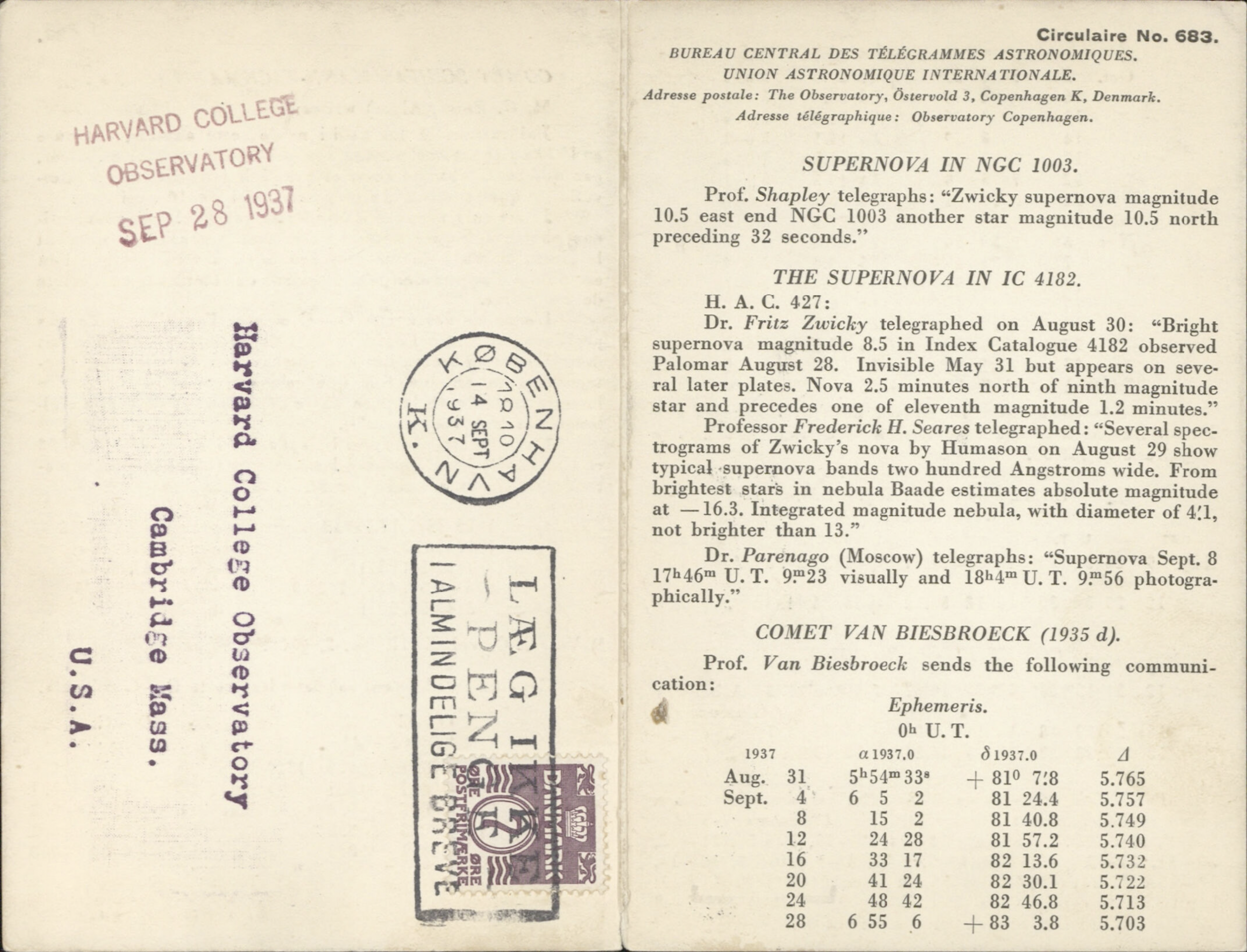
One supernova has been observed in NGC 1003: SN 1937D (Type Ia, mag. 10.5) was discovered by Fritz Zwicky on 9 September 1937.
Text derived from https://en.wikipedia.org/w/index.php?oldid=1377881964 under CC BY-SA 4.0; modifications have been made.