NGC 1073
NGC 1073 is a barred spiral galaxy in the constellation Cetus.
≈ 2 min read
Names in other languages
No names in other languages are held for this entry yet.
Article bodies are English and are not machine-translated. A name in another language is not a translation of the article.
NGC 1073 is a barred spiral galaxy in the constellation Cetus. The galaxy is estimated to be about 55 million light years from Earth, possess a disk spanning an estimated 80,000 light years in diameter, and likely contains a type of active core, called an HII nucleus. It was discovered by German-British astronomer William Herschel on 9 October 1785.
NGC 1073 is similar to the Milky Way only in their shared possession of a galactic bar. NGC 1073, however, does not possess the well-defined symmetrical arm structure the Milky Way exhibits, and retains a central bar larger than our home galaxy's. NGC 1073 can be viewed with a mid-sized telescope in rural, dark skies.
NGC 1073 is a member of a galaxy group known as LGG 73, which contains 7 galaxies, NGC 1068, NGC 1055, UGCA 44, UGC 2302, UGC 2275 and UGC 2162.
Supernova
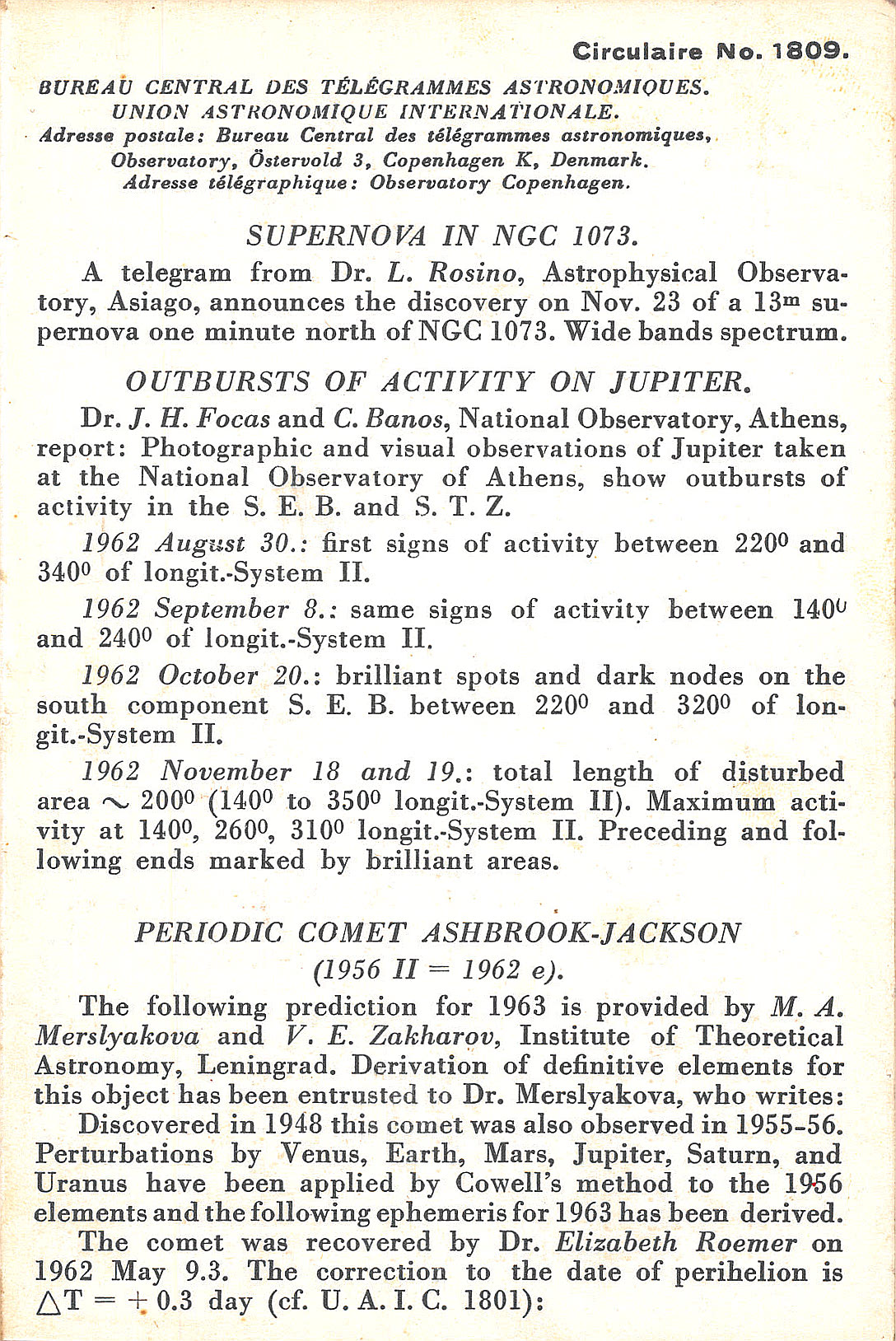
One supernova has been observed in NGC 1073: SN 1962L (Type Ic, mag. 13.9) was discovered by Leonida Rosino on 23 November 1962, and independently by Enrique Chavira and Guillermo Haro.
External links
Video (01:18)
Text derived from https://en.wikipedia.org/w/index.php?oldid=1377882022 under CC BY-SA 4.0; modifications have been made.