NGC 1084
NGC 1084 is an unbarred spiral galaxy in the constellation Eridanus.
≈ 3 min read
Names in other languages
No names in other languages are held for this entry yet.
Article bodies are English and are not machine-translated. A name in another language is not a translation of the article.
NGC 1084 is an unbarred spiral galaxy in the constellation Eridanus. It is located at a distance of about 63 million light-years away from the Milky Way. The galaxy was discovered by William Herschel on 10 January 1785.
It has multiple spiral arms, which are not well defined. It belongs in the same galaxy group with NGC 988, NGC 991, NGC 1022, NGC 1035, NGC 1042, NGC 1047, NGC 1052 and NGC 1110. This group is in turn associated with the Messier 77 group.
Star formation in the galaxy is chaotic and not confined to the spiral arms, but the rate is not high enough to classify it as a starburst galaxy. Star formation has taken place in small bursts in the last 40 million years. The cause of this activity has been proposed as a merger with a gas-rich dwarf galaxy.
A radio source has been detected 3.5' south-west of the galaxy, connected to it by a bridge.
Supernovae
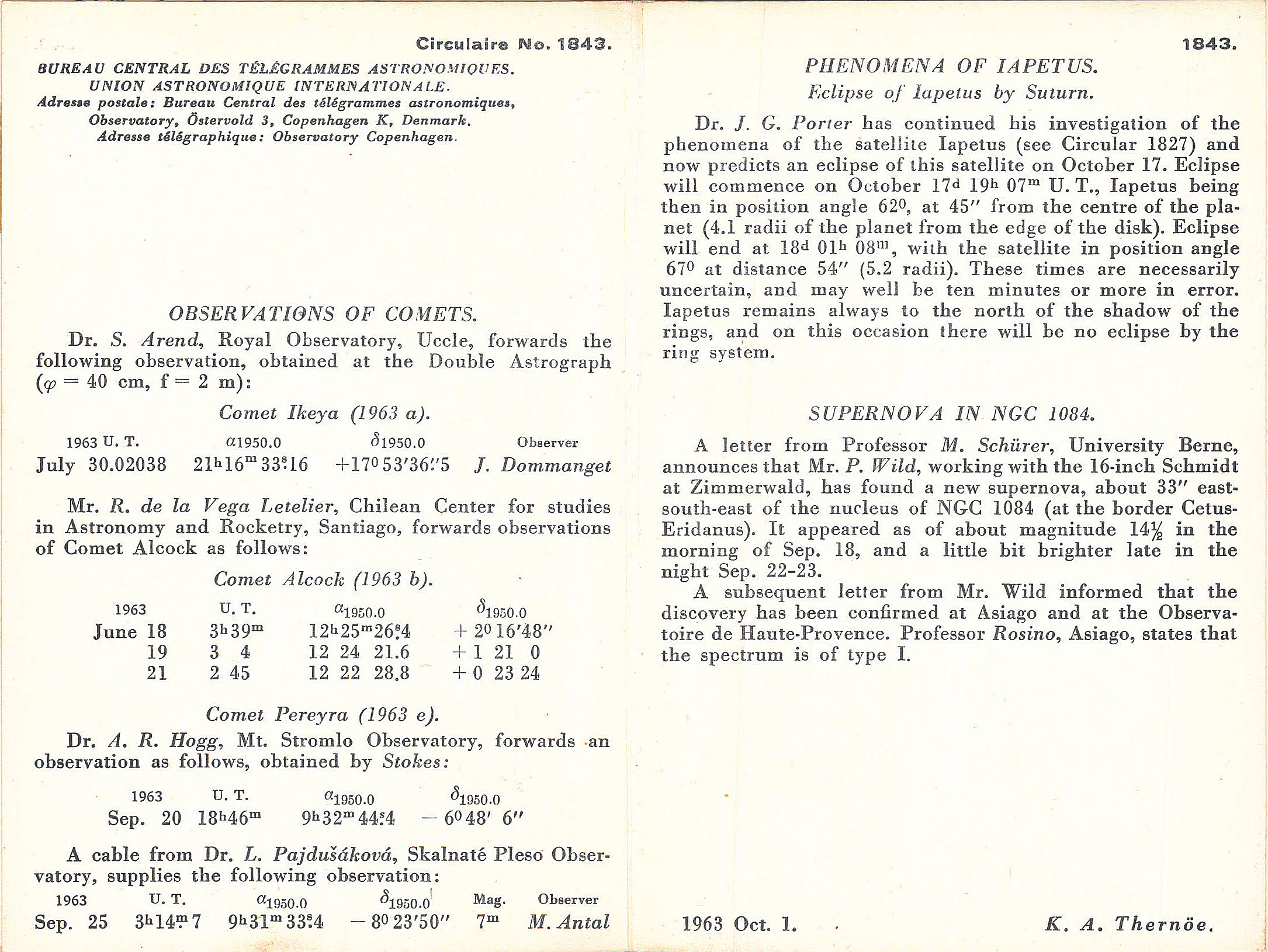
Five supernovae have been observed in NGC 1084: SN 1963P (Type Ia, mag. 14.5) was discovered by Paul Wild on 18 September 1963. SN 1996an (Type II, mag.
14) was discovered by Masakatsu Aoki on 27 July 1996. SN 1998dl (Type II, mag. 16) was discovered by the Lick Observatory Supernova Search (LOSS) on 20 August 1998.
SN 2009H (Type II, mag. 17.4) was discovered by the Lick Observatory Supernova Search (LOSS) on 2 January 2009. SN 2012ec (Type II-P, mag.
14.5) was discovered by on 11 August 2012.
Text derived from https://en.wikipedia.org/w/index.php?oldid=1377882047 under CC BY-SA 4.0; modifications have been made.