NGC 4096
NGC 4096 is a spiral galaxy in the constellation Ursa Major.
≈ 3 min read
Names in other languages
No names in other languages are held for this entry yet.
Article bodies are English and are not machine-translated. A name in another language is not a translation of the article.
NGC 4096 is a spiral galaxy in the constellation Ursa Major. The galaxy lies about 35 million light years away from Earth, which means, given its apparent dimensions, that NGC 4096 is approximately 80,000 light years across. It was discovered by William Herschel on March 9, 1788.
NGC 4096 is a spiral galaxy visible with an inclination of 76°. Although the presence of a bar has been suggested, it hasn't been proven. The galaxy has multiple well-defined thin arms.
NGC 4096 is asymmetric in the north–south axis, with the northern half having stronger CO emissions and asymmetric H I and H-alpha emissions following a lopsided spiral arm. The total stellar mass of the galaxy is estimated to be . The star formation rate of the galaxy is estimated to be between 0.22 and 0.43 per year.
Garcia in 1993 considered the galaxy to be a member of LGG 269 group, along with NGC 4111, NGC 3938, NGC 4051, and NGC 4138. On the other hand, Makarov et al. consider the galaxy to be a member of the Messier 106 Group, along with Messier 106, NGC 4242, NGC 4248, NGC 4288 and NGC 4460. The group is part of the Local Supercluster.
Supernovae
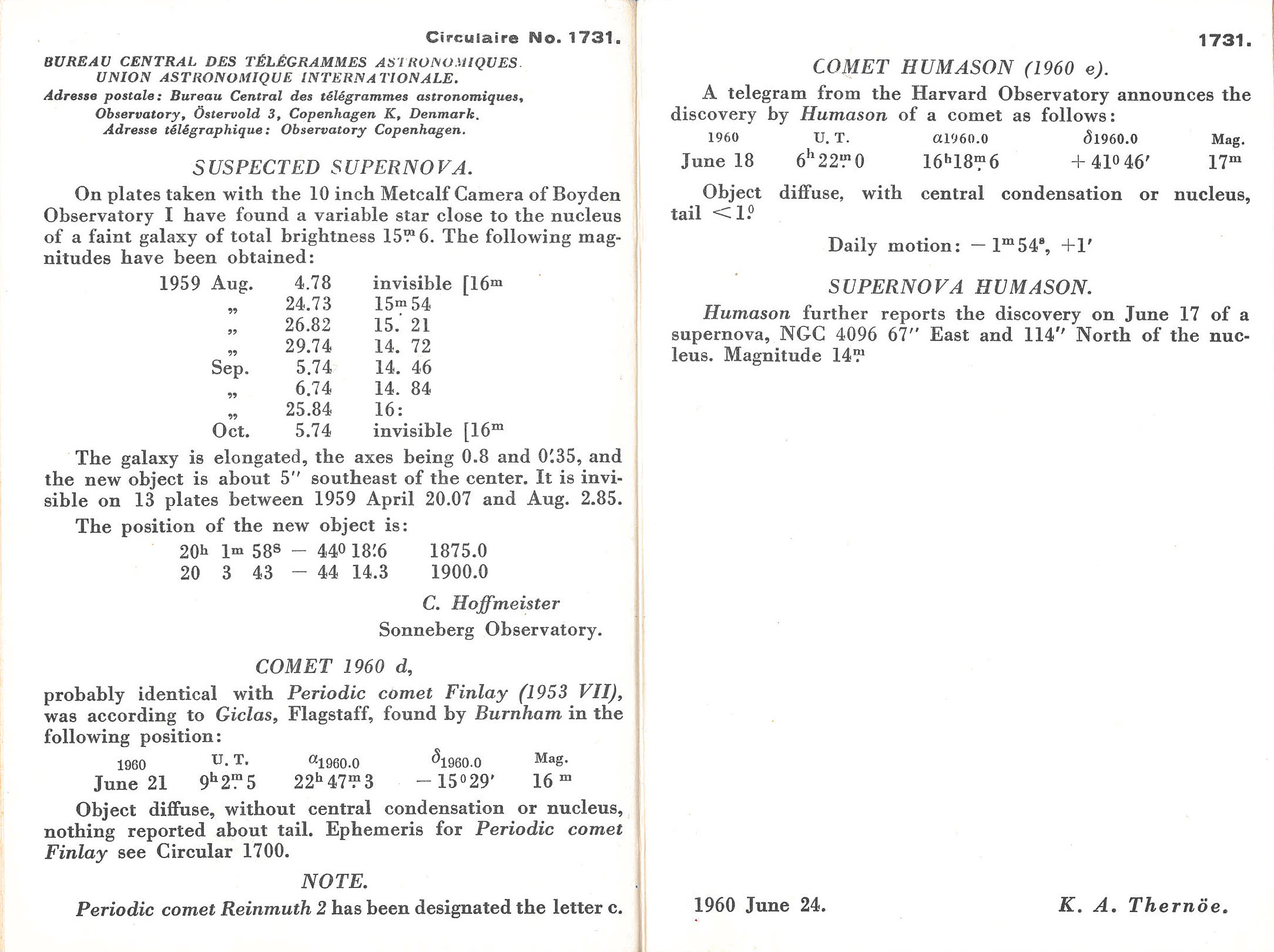
Two supernovae have been detected in NGC 4096. SN 1960H (Type Ia-pec, mag. 14) was discovered by Milton Humason on 17 June 1960, and independently by Paul Wild on 20 June 1960.
SN 2014bi (Type II-P, mag. 18.2) was discovered by the Lick Observatory Supernova Search (LOSS) on 31 May 2014. It was low-luminosity, and the spectrum indicated it was about two weeks post maximum and significantly reddened.
Text derived from https://en.wikipedia.org/w/index.php?oldid=1377882410 under CC BY-SA 4.0; modifications have been made.