NGC 5253
NGC 5253 is an irregular galaxy in the constellation Centaurus.
≈ 1 min read
Names in other languages
No names in other languages are held for this entry yet.
Article bodies are English and are not machine-translated. A name in another language is not a translation of the article.
NGC 5253 is an irregular galaxy in the constellation Centaurus. It was discovered by William Herschel on 15 March 1787.
Properties
NGC 5253 is located within the M83 Subgroup of the Centaurus A/M83 Group, a relatively nearby galaxy group that includes the radio galaxy Centaurus A and the spiral galaxy M83 (the Southern Pinwheel Galaxy). NGC 5253 is considered a dwarf starburst galaxy and also a blue compact galaxy.
Supernovae
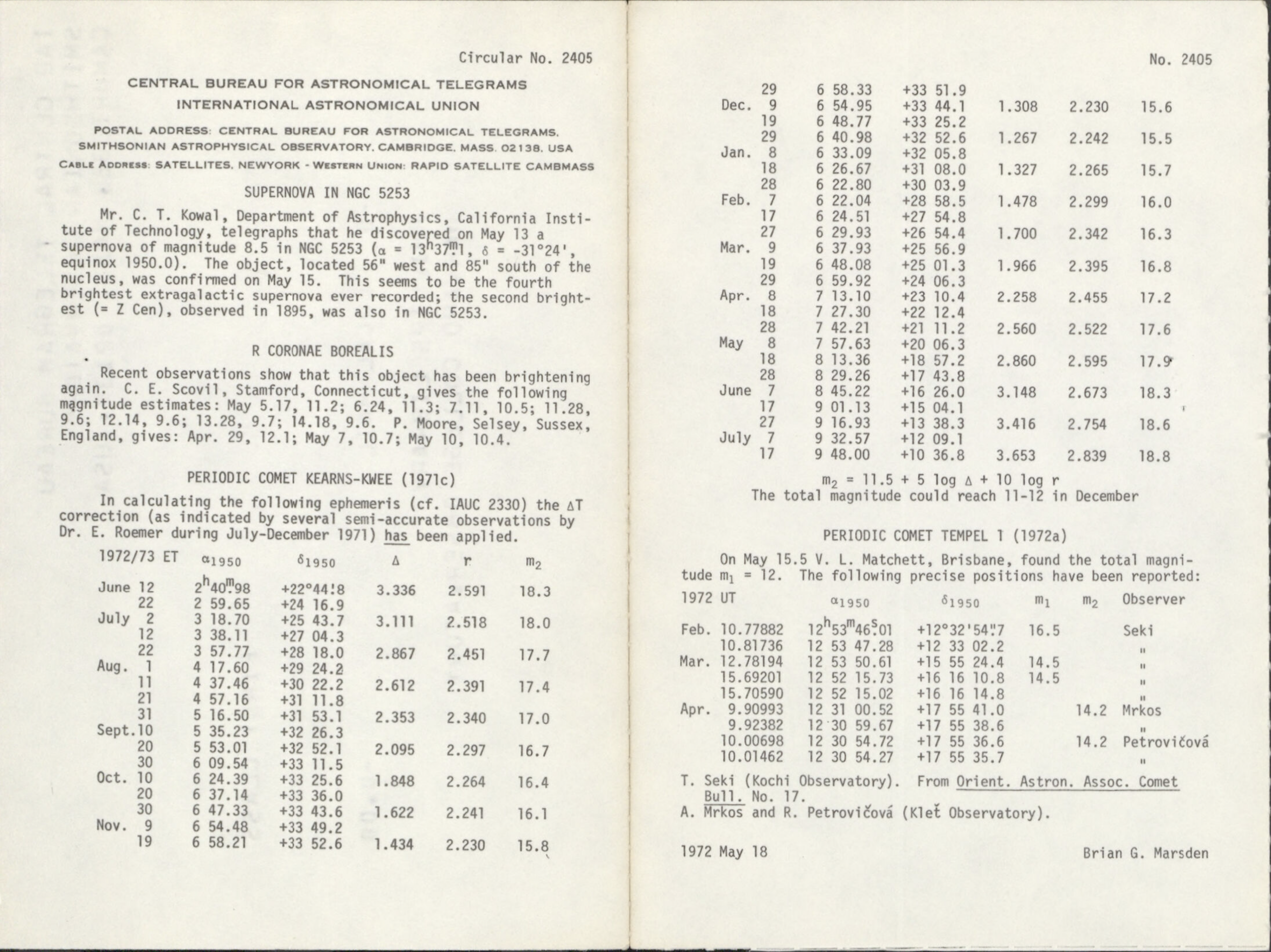
Two supernovae have been observed in NGC 5253: SN 1895B (type unknown, mag. 8) was discovered by Williamina Fleming on 7 July 1895. SN 1972E (Type Ia, mag.
8.5), the second-brightest recent supernova visible from Earth, was discovered by Charles Kowal on 13 May 1972. With a peak apparent magnitude of 8.5, the only brighter supernova observed in the 20th century was SN 1987A.
Contents
NGC 5253 contains a giant dust cloud hiding a cluster (believed to be a super star cluster) of more than one million stars, among them up to 7,000 O-type stars. The cluster is 3 million years old and has a total luminosity of more than one billion suns. It is the site of efficient star formation, with a rate at least 10 times higher than comparable regions in the Milky Way.
Image gallery
File:A Peculiar Compact Blue Dwarf Galaxy.jpg|NGC 5253 imaged by the Hubble Space Telescope File:NGC 5253 (ACS-HRC) (potw2426b).jpg|The nucleus of NGC 5253 imaged by the Hubble Space Telescope
Text derived from https://en.wikipedia.org/w/index.php?oldid=1377882946 under CC BY-SA 4.0; modifications have been made.