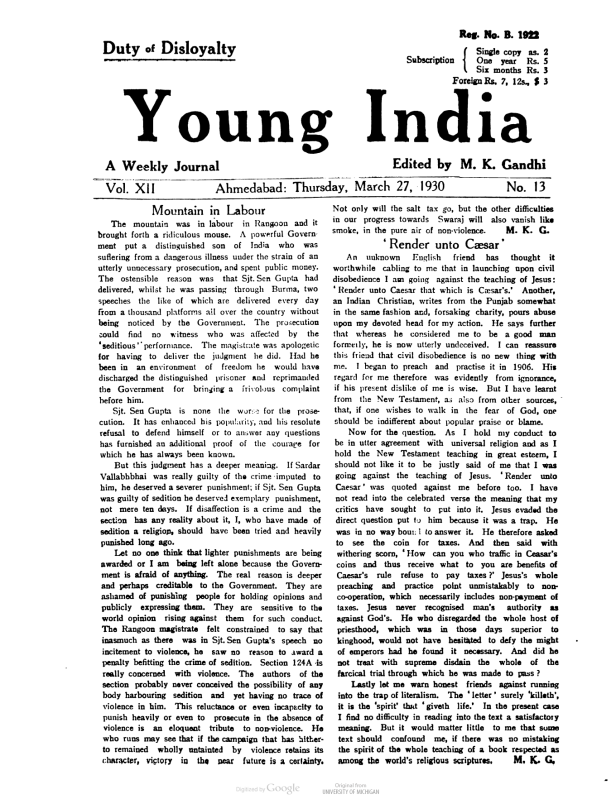
Render unto Caesar
a phrase attributed to Jesus in the synoptic gospels
≈ 13 min read
Names in other languages
- ItalianoDate a Cesare quello che è di Cesare e a Dio quello che è di Dio
- brReddite ergo quæ Cæsaris sunt Cæsari et quæ Dei sunt Deo
- PortuguêsA César o que é de César...
- MagyarAdjuk meg a császárnak…
- EnglishRender unto Caesar
- shDajte caru carevo
- СрпскиDajte caru carevo
- РусскийКесарю кесарево
Article bodies are English and are not machine-translated. A name in another language is not a translation of the article.
, by Titian (1516), depicts Jesus being shown the tribute penny. "Render unto Caesar" is the beginning of a phrase attributed to Jesus in the synoptic gospels, which reads in full, "Render therefore unto the things which are ; and unto God the things that are God's" (KJV).
This phrase has become a widely quoted summary of the relationship between Christianity, secular government, and society. The original message, coming in response to a question of whether it was lawful for Jews to pay taxes to Caesar, gives rise to multiple possible interpretations about the circumstances under which it is desirable for Christians to submit to earthly authority.
Narrative
All three synoptic gospels state that hostile questioners tried to trap Jesus into taking an explicit and dangerous stand on whether Jews should or should not pay taxes to the Roman authorities. The accounts in and say that the questioners were Pharisees and Herodians, while says only that they were "spies" sent by "teachers of the law and the chief priests".
They anticipated that Jesus would oppose the tax, as their purpose was "to hand him over to the power and authority of the governor". The governor was Pilate, and he was the man responsible for the collecting of taxes in Roman Judea. Initially the questioners flattered Jesus by praising his integrity, impartiality, and devotion to truth.
Then they asked him whether or not it is right for Jews to pay the taxes demanded by Caesar. In the Gospel of Mark the additional, provocative question is asked, "Should we pay or shouldn't we?" , by Rubens (1610–1615) Jesus first called them hypocrites, and then asked one of them to produce a Roman coin that would be suitable for paying Caesar's tax.
One of them showed him a Roman coin, and he asked them whose head and inscription were on it. They answered, "Caesar's," and he responded: "Render therefore unto Caesar the things which are Caesar's, and unto God the things that are God's". states that they "marvelled" ( ); unable to trap him any further, and being satisfied with the answer, they went away.
A similar episode occurs in the apocryphal Gospel of Thomas (verse 100), but there the coin in question is gold. Importantly, in this non-canon gospel, Jesus adds, "and give me what is mine."
The same episode occurs in a fragment of the also apocryphal Egerton Gospel: Jesus is asked whether it is right to pay taxes to the rulers (i.e. the Romans), to which he becomes indignant and criticizes the questioners by quoting the Book of Isaiah; the fragment is interrupted immediately after that.
The coin
featuring Tiberius. The inscription on the obverse reads Ti[berivs] Caesar Divi Avg[vsti] F[ilivs] Avgvstvs ("Caesar Augustus Tiberius, son of the Divine Augustus"), and the reverse reads Pontif[ex] Maxim[us] ("Highest Priest"). The text identifies the coin as a ( ), and it is usually thought that the coin was a Roman denarius with the head of Tiberius, the emperor at the time.
The coin is also called the "tribute penny." The inscription reads "Ti[berivs] Caesar Divi Avg[vsti] F[ilivs] Avgvstvs" ("Caesar Augustus Tiberius, son of the Divine Augustus"). The reverse shows a seated female, usually identified as Livia depicted as Pax.
However, it has been suggested that denarii were not in common circulation in Judaea during Jesus' lifetime and that the coin may have instead been an Antiochan tetradrachm bearing the head of Tiberius, with Augustus on the reverse. Another suggestion often made is the denarius of Augustus with Caius and Lucius on the reverse, while coins of Julius Caesar, Mark Antony, and Germanicus are all considered possibilities.
Tax resistance in Judaea
The taxes imposed on Judaea by Rome had led to riots. New Testament scholar Willard Swartley writes: The tax denoted in the text was a specific tax... It was a poll tax, a tax instituted in A.D. 6.
A census taken at that time (cf. Lk. 2:2) to determine the resources of the Jews provoked the wrath of the country. Judas of Galilee led a revolt (Acts 5:37), which was suppressed only with some difficulty.
Many scholars date the origin of the Zealot party and movement to this incident. The Jewish Encyclopedia says of the Zealots: When, in the year 5, Judas of Gamala in Galilee started his organized opposition to Rome, he was joined by one of the leaders of the Pharisees, R. Zadok, a disciple of Shammai and one of the fiery patriots and popular heroes who lived to witness the tragic end of Jerusalem...
The taking of the census by Quirinus, the Roman procurator, for the purpose of taxation was regarded as a sign of Roman enslavement; and the Zealots' call for stubborn resistance to the oppressor was responded to enthusiastically. At his trial before Pontius Pilate, Jesus was accused of promoting resistance to Caesar's tax.
Then the whole company of them arose and brought him before Pilate. And they began to accuse him, saying, "We found this man misleading our nation and forbidding us to give tribute to Caesar, and saying that he himself is Christ, a king."
( ) Basing his argument partially on this passage, theologian S. G. F. Brandon argued that, if the parable reflects an authentic statement of Jesus, it must have been clear to his audience that he was opposed to paying the Roman tax, at least in land or the products of the land (the "things of God") as opposed to payment in Roman coin (the "things of Caesar"). Brandon concludes that the treatment of this episode in the Gospel of Mark (which most scholars believe was the earliest written) was crafted so as to obscure Jesus's potentially seditious viewpoint from his audience of Roman Christians around the time of the First Jewish–Roman War.
Interpretations
The passage has been much discussed in the modern context of Christianity and politics, especially on the questions of separation of church and state and tax resistance.
Christology
Augustine of Hippo suggested an interpretation of the gospel episode in his Confessions, where he writes He himself, the only-begotten, was created to be wisdom and justice and holiness for us, and he was counted among us, and he paid the reckoning, the tribute to Caesar. In other words, Saint Augustine explains that Jesus became human and fulfilled his earthly obligations, such as paying taxes to the Roman authorities.
Augustine thus uses the episode to explain his Christology regarding Jesus nature, which he sees as being at the same time divine and human.
Separation of church and state
Jesus responds to Pontius Pilate about the nature of his kingdom: "My kingdom is not of this world. If my kingdom were of this world, my servants would have been fighting, that I might not be delivered over to the Jews. But now (or 'as it is') my kingdom is not from the world" ( ); i.e., his religious teachings were separate from earthly political activity.
This reflects a traditional division in Christian thought by which state and church have separate spheres of influence. This can be interpreted in either a Catholic, or Thomist, way (Gelasian doctrine) or a Protestant, or Lockean, way (separation of church and state).
Tertullian, in De Idololatria, interprets Jesus as saying to render "the image of Caesar, which is on the coin, to Caesar, and the image of God, which is on man, to God; so as to render to Caesar indeed money, to God yourself. Otherwise, what will be God's, if all things are Caesar's?"
Justification for following laws
Some read the phrase "Render unto Caesar that which is Caesar's" as unambiguous at least to the extent that it commands people to respect state authority and to pay the taxes it demands of them. Paul the Apostle also states in that Christians are obliged to obey all earthly authorities, stating that as they were introduced by God, disobedience to them equates to disobedience to God.
In this interpretation, Jesus asked his interrogators to produce a coin in order to demonstrate to them that by using his coinage they had already admitted the de facto rule of the emperor, and that therefore they should submit to that rule.
Respecting obligations when enjoying advantages
(1625) Some see the parable as being Jesus' message to people that if they enjoy the advantages of a state such as Caesar's, as distinct from God's authority (for instance, by using its legal tender), they cannot subsequently choose to ignore the laws of such a state. Henry David Thoreau writes in Civil Disobedience: Christ answered the Herodians according to their condition.
"Show me the tribute-money," said he; – and one took a penny out of his pocket; – If you use money which has the image of Caesar on it, and which he has made current and valuable, that is, if you are men of the State, and gladly enjoy the advantages of Caesar's government, then pay him back some of his own when he demands it; "Render therefore to Caesar that which is Caesar's and to God those things which are God's" – leaving them no wiser than before as to which was which; for they did not wish to know. (1602) Mennonite Dale Glass-Hess wrote: It is inconceivable to me that Jesus would teach that some spheres of human activity lie outside the authority of God.
Are we to heed Caesar when he says to go to war or support war-making when Jesus says in other places that we shall not kill? No! My perception of this incident is that Jesus does not answer the question about the morality of paying taxes to Caesar, but that he throws it back on the people to decide.
When the Jews produce a denarius at Jesus' request, they demonstrate that they are already doing business with Caesar on Caesar's terms. I read Jesus' statement, "Give to Caesar..." as meaning "Have you incurred a debt in regard to Caesar! Then you better pay it off."
The Jews had already compromised themselves. Likewise for us: we may refuse to serve Caesar as soldiers and even try to resist paying for Caesar's army. But the fact is that by our lifestyles we've run up a debt with Caesar, who has felt constrained to defend the interests that support our lifestyles.
Now he wants paid back, and it's a little late to say that we don't owe anything. We've already compromised ourselves. If we're going to play Caesar's games, then we should expect to have to pay for the pleasure of their enjoyment.
But if we are determined to avoid those games, then we should be able to avoid paying for them. Mohandas K. Gandhi shared this perspective. He wrote: Jesus evaded the direct question put to him because it was a trap.
He was in no way bound to answer it. He therefore asked to see the coin for taxes. And then said with withering scorn, "How can you who traffic in Caesar's coins and thus receive what to you are benefits of Caesar's rule refuse to pay taxes?"
Jesus' whole preaching and practice point unmistakably to noncooperation, which necessarily includes nonpayment of taxes.
Roman Catholic
The German theologian Justus Knecht gives the Roman Catholic interpretation: Obedience to temporal authority. We are not only allowed, but commanded to obey the authority of the state, and to pay such taxes &c. as are a due; for the authority of the state is ordained by God to protect the lives and property of subjects.
If there were no temporal authority, disorder, robbery, murder &c. would be rampant; and, therefore, as the authority of the state exists for the good of subjects, it is the duty of these last to pay those taxes &c. without which it cannot be kept up.
Versions
The extracanonical Gospel of Thomas also has a version, which reads in the Stephen Patterson and Marvin Meyer Version 100: They showed Jesus a gold coin and said to him, "The Roman emperor's people demand taxes from us." He said to them, "Give the emperor what belongs to the emperor, give God what belongs to God, and give me what is mine." The fragmentary Egerton Gospel in the Scholar's Version translation (found in The Complete Gospels) 3:1–6 reads: They come to him and interrogate him as a way of putting him to the test.
They ask, "Teacher, Jesus, we know that you are [from God], since the things you do put you above all the prophets. Tell us, then, is it permissible to pay to rulers what is due them? Should we pay them or not?"
Jesus knew what they were up to, and became indignant. Then he said to them, "Why do you pay me lip service as a teacher, but not [do] what I say? How accurately Isaiah prophesied about you when he said, 'This people honors me with their lips, but their heart stays far away from me; their worship of me is empty, [because they insist on teachings that are human] commandments [...]'
Modern references
In the United States Supreme Court case of Tyler v. Hennepin County (2023), chief justice John Roberts referenced the phrase in the court's opinion regarding the Takings Clause and state property taxes. The chief justice explained the court's holding by stating that "[t]he taxpayer must render unto Caesar what is Caesar’s, but no more."
See also
Caesaropapism Christianity and politics Coin in the fish's mouth Doctrine of the two kingdoms Fiscus Judaicus Parables of Jesus King Canute and the tide Romans 13, another Biblical discussion of how Christians should interact with secular authorities
External links
How Politicians and Messiahs Avoid Giving Straight Answers – A tax resister's point-of-view Render to All What Is Due Them: What Every Christian Needs to Know about Honoring Civil Authority and Paying Taxes, Part 2 by David G. Hagopian – advancing the argument that Jesus commanded people to pay taxes to their de facto rulers – A comprehensive analysis of everything Jesus said or did relative to taxes and tax collectors as recorded in the canon and non-canon gospels. Render Unto Caesar by R.J. Rushdoony – Christian Reconstructionist perspective.
Text derived from https://en.wikipedia.org/w/index.php?oldid=1361095995 under CC BY-SA 4.0; modifications have been made.