Ringette
≈ 13 min read
Names in other languages
No names in other languages are held for this entry yet.
Article bodies are English and are not machine-translated. A name in another language is not a translation of the article.
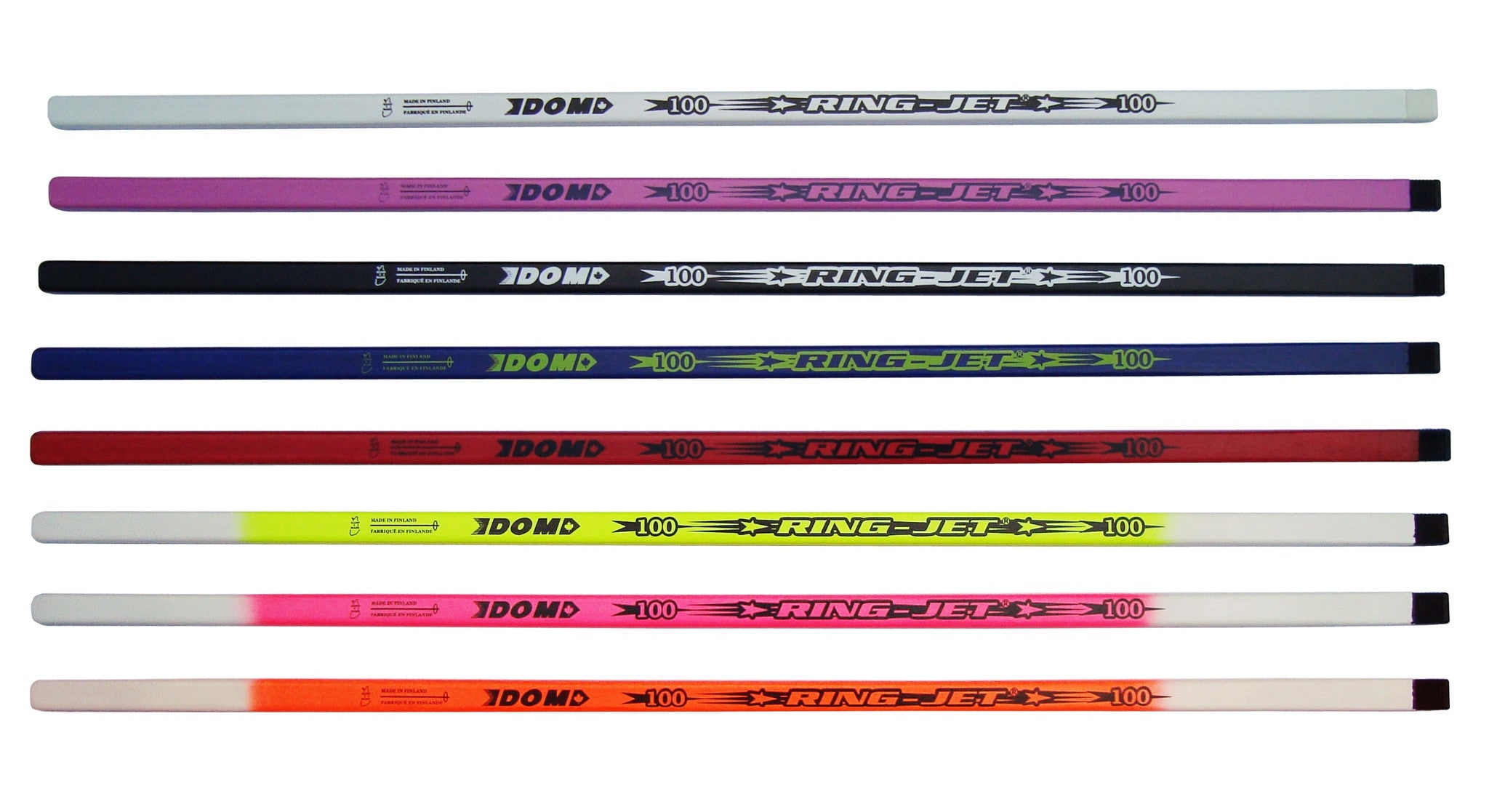
Ringette is a winter team sport played on an ice rink using ice hockey skates, straight sticks with drag-tips, and a blue, rubber, pneumatic ring designed for use on ice surfaces. While the sport was originally created exclusively for female competitors, it has expanded to now include participants of all gender identities. Although ringette is similar to ice hockey and is played on ice hockey rinks, the sport has its own lines and markings, and its offensive and defensive play bear a closer resemblance to lacrosse or basketball. The sport was created in Canada in 1963 by Sam Jacks from West Ferris, Ontario, and Red McCarthy from Espanola, Ontario. Since then, it has gained popularity to the point where, in 2018, more than 50,000 individuals, including coaches, officials, volunteers, and over 30,000 players, registered to take part in the sport in Canada alone. The sport has continued to grow and has spread to other countries including the United Arab Emirates. Two different floor variants of ringette are also played: in-line ringette, and gym ringette. Ringette is especially popular in Canada and Finland, having come to prominence as national pastimes in both countries. The premier international competition for ringette is the World Ringette Championships (WRC) which is organized by the International Ringette Federation (IRF).…
Ringette is a winter team sport played on an ice rink using ice hockey skates, straight sticks with drag-tips, and a blue, rubber, pneumatic ring designed for use on ice surfaces. While the sport was originally created exclusively for female competitors, it has expanded to now include participants of all gender identities. Although ringette is similar to ice hockey and is played on ice hockey rinks, the sport has its own lines and markings, and its offensive and defensive play bear a closer resemblance to lacrosse or basketball. The sport was created in Canada in 1963 by Sam Jacks from West Ferris, Ontario, and Red McCarthy from Espanola, Ontario. Since then, it has gained popularity to the point where, in 2018, more than 50,000 individuals, including coaches, officials, volunteers, and over 30,000 players, registered to take part in the sport in Canada alone. The sport has continued to grow and has spread to other countries including the United Arab Emirates. Two different floor variants of ringette are also played: in-line ringette, and gym ringette. Ringette is especially popular in Canada and Finland, having come to prominence as national pastimes in both countries. The premier international competition for ringette is the World Ringette Championships (WRC) which is organized by the International Ringette Federation (IRF). On the international stage, Canadian teams and Finnish teams have proved to be the most successful and are regularly at the top of the rankings. Several other countries currently organize and compete in the sport including Sweden, the United States, the Czech Republic, and Slovakia, all of whom have national ringette teams though Slovakia has not competed since the 2016 World Ringette Championships. National organizations for the sport include Ringette Canada, Ringette Finland, the Sweden Ringette Association, USA Ringette, the Czech Ringette Association, and the Slovakia Ringette Association. The sport is also played at the semi-professional level in Canada (National Ringette League), in Finland (SM–Ringette), and in Sweden (Ringette Dam-SM), as well as the university and college level. In Canada, the sport is a part of the Canada Winter Games programme and the annual Canadian Ringette Championships serves as the country's premier competition for the sport's elite amateur athletes. The sport's first international tournament was hosted in Finland in 1986.
Goaltenders
Goalies in ringette use protective equipment that is similar to the equipment used in ice hockey. While ice hockey goaltending equipment is used, there are a few differences. For example, goalies in ringette wear leg pads and use the same goalie skates and goalie stick as goalies in hockey. Nonetheless, goalies are required to wear a combination of a ringette-approved helmet, facemask, and throat protector. Moreover, they must also wear genital protection, chest and arm protectors, and pants. On the free hand, also known as the glove side, a glove known as a "catcher" or simply a "glove" is worn. For their glove side, goaltenders may use an ice hockey trapper, an ice hockey blocker, a glove like a player's glove or lacrosse glove, or a ringette goalie trapper "Keely glove", named after a Keely Brown, a former goalie of Canada's national ringette team who helped create the sport's first design. A custom prosthetic Keely glove design has been developed for a one-handed goalie.
Variants
There are two off-ice variants of ringette: in-line ringette and gym ringette, played wearing shoes. Gym ringette was developed in Canada as a floor variant of ringette in the 1990s, largely by Ringette Canada. It is meant to be played as a stand-alone activity or as a form of dry-land training to help players develop skills which are transferable to the ice sport. In-line ringette is played as an informal alternative, but a consistent set formal rules have not been codified and sizeable organizing bodies do not exist. Ringette does not have any parasport variant.
Development
Ringette was created in Northern Ontario, Canada, as a civic recreation project for girls by its two founders, Sam Jacks from North Bay, Ontario, and Red McCarthy from Espanola, Ontario. Jacks is credited with creating the idea for the sport in 1963, following his earlier development of a variant of floor hockey in 1936, which used bladeless sticks and a flat felt disk with a hole in the centre. McCarthy was responsible for developing the sport's first rules. Ringette was created in the hopes of increasing and maintaining female participation in winter sports under the existing authority of the Society of Directors of Municipal Recreation of Ontario (SDMRO) and the Northern Ontario Recreation Directors Association (NORDA) due to a lack of success in generating interest among the young female population in the winter team sports of girls' broomball and girls' ice hockey. arena in 1966. ]] The idea for the new game was first introduced at a general meeting between the members of NORDA in January 1963 in Sudbury, Ontario. The first ringette game took place that fall in Espanola, Ontario under the direction of McCarthy between a group of girls who had played ice hockey at Espanola High School. Other Northern Ontario communities soon began experimenting with the game in the winter of 1964–65. On May 31, 19651, a set of rules developed by McCarthy were presented by NORDA to the SDMRO which then published them for use in the 1965–66 season. The SDMRO then developed and organized the sport on a larger scale, and in 1969 the Ontario Ringette Association (now Ringette Ontario) became the first provincial ringette association in history and was formed as a provincial governing body with a $229.27 provincial government grant ( ) and 1,500 players in 14 locations. The sport was introduced to Manitoba in 1967 and the province's first team, the Wildwood, was created two years later in Fort Garry, Winnipeg.
Growth
In Canada, ringette spread to Manitoba, Quebec, Nova Scotia and British Columbia. To better organize the sport nationally, Ringette Canada was founded in 19741. The following year, the sport received national television exposure in an intermission feature during Hockey Night in Canada. The copyright to the official ringette rules, which had been transferred from the SDMRO to the Ontario Ringette Association in 1973, was acquired by Ringette Canada in 1983. After Jacks died in May 19751, his wife Agnes Jacks promoted the game and acted as an ambassador for the sport until her own death in April 2005. She received the Order of Canada for this work in 2002. Ringette Canada initially had little money and received no assistance from the Canadian federal government though the sport grew significantly between the 1970s and 1980s. In 1979, former professional Finnish ice hockey player and coach Juhani Wahlsten introduced ringette to Finland at girls' ice hockey practices in the Turku area. The first recorded game in Finland took place on January 23, 1979, and the first tournament took place in early 1980. Meanwhile, Alpo Lindström and his son Jan Lindström brought ringette to Naantali near the end of 1979, the same year Juhani Wahlsten brought the sport to Finland for the first time. Jan had been an exchange student in the United States the previous year, 1978, and had seen girls playing ringette. When he returned to Finland, he founded VG-62's ringette club, VG-62 (ringette). The game quickly gained popularity, aided by Canadian coaches who helped establish programs. In 1983, a national association was established, which organized tournaments of more than a hundred matches by the mid-1980s. Ringette spread to Sweden in the early 1980s. The league Ringette Dam-SM was formed in 19941, along with the Sweden Ringette Association was also established in 1994. Ringette was introduced to the Midwestern United States in the mid-1970s and had gained popularity by the 1980s with most activity centred in Minnesota. However, participation fell dramatically in the mid-1990s when ice hockey was endorsed over ringette as an official high school sport for girls. In 1986, the World Ringette Council was founded in Finland to promote and develop the sport internationally and to establish international competitions. The World Ringette Championships were first held in 1990. The following year, the World Ringette Council changed its name to the International Ringette Federation (IRF), possibly to avoid confusion due to the fact that it had the same acronym as the world event.
Ringette by country
Czech Republic
The Czech Republic is host to an annual international ringette tournament in Europe, the Czech Ringette Challenge Cup and the Czech Republic national ringette team competes in the World Ringette Championships. The Czech Republic made its first international appearance at the 2016 World Ringette Championships. It was also host of the first ever World Junior Ringette Championships (Under-19) in Prague in 2009. The national governing body for ringette in the country is the Czech Ringette Association.
Japan
In 1982, ringette was introduced in Japan by former Ringette Canada President, Barry Mattern.
Australia and New Zealand
In 1986, ringette was introduced to Australia and New Zealand via the "Maples Ringette tour".
Soviet Union
In 1984, a sports delegation helped introduce ringette to the U.S.S.R. In 1985, ringette was again introduced via an initiative called 'Ringette in Russia' by the St. James Ringette Association of Winnipeg, Manitoba. However, within two years it became evident that the sport had failed to take hold in the Soviet Union.
Other countries
The international development of the sport has continued with the formation of associations in Estonia, Slovakia, and France. Furthermore, Ringette Canada has been instrumental in spreading the game to the Netherlands, Switzerland, and West Germany. The sport has also been introduced to South Africa and the United Arab Emirates.
Impact
Ice hockey
Ringette has had an unintentional influence on the sport of ice hockey, including a minor effect on men's professional ice hockey and a larger impact on girls' and women's ice hockey. The "ringette line" began to have a potential impact on men's professional ice hockey in 2012 in regards to the American Hockey League with several professionals including Toronto Maple Leafs general manager Brian Burke considering its possible application in ice hockey to correct areas of concern about the game. Ringette concepts and rings have been used in professional ice hockey practices since the late 1970s, when the Toronto Maple Leafs head coach Roger Neilson sought to add variation to practices. After observing this, the coach of the Czechoslovakia men's national ice hockey team, Karel Gut, took notes on the game and made modifications to apply it to a training system used in Czechoslovakia's university ice hockey teams. Prior to the 1990s in Canada, the development of women's ice hockey had failed and growth stagnated. In Ontario where ringette was invented, there were only 101 female ice hockey teams existing in the province by 1976. By 1983, there were over 14,500 ringette players in Canada compared to only 5,379 female ice hockey players. By 1990–91 there were still only 8,146. Female ice hockey only began to experience significant growth after it banned body checking, which was mostly accomplished in Canada by 1986. Following this, the expansion of female ice hockey in Canada was largely accomplished by aggressive recruiting from the ringette system.
Culture
Ringette remains one of the few organized sports worldwide where most of its elite athletes identify as women rather than men. Many women's sports are variants of male-dominated sports and are meant to serve as the female equivalent, rather than being sports developed for females . Canadian media and parts of the ringette community increasingly avoid calling ringette a girls' sport in spite of its heritage.
Finland
Susanna Tapani Anna Vanhatalo Salla Kyhälä Marjukka Virta Anne Pohjola Petra Ojaranta Petra Vaarakallio – a national team member who stopped playing after receiving a six-month suspension for kicking a fallen opponent
Canada
Keely Brown (goaltender) Shelly Hruska Julie Blanchette Stéphanie Séguin Erin Cumpstone Judy Diduck - member of the first Canadian ringette team to win the World Ringette Championships in 1990
Further reading
Collins, Kenneth Stewart (2004). The Ring Starts Here: An Illustrated History of Ringette. Hall, Margaret Ann (2016). The Girl and the Game: A History of Women's Sport in Canada. University of Toronto Press. Hall, Margaret Ann; Pfister, Gertrud. Honoring the Legacy: Fifty Years of the International Association of Physical Education and Sport for Girls and Women.
Text derived from https://en.wikipedia.org/w/index.php?oldid=1368766651 under CC BY-SA 4.0; modifications have been made.