Tropical night
intensifies the heat island effect during tropical nights.
≈ 5 min read
Names in other languages
No names in other languages are held for this entry yet.
Article bodies are English and are not machine-translated. A name in another language is not a translation of the article.
intensifies the heat island effect during tropical nights. "Tropical night" is a term used in many European countries to describe days when the temperature does not fall below during the nighttime.
This definition is in use in countries including Austria, Belgium, Croatia, Denmark, Estonia, Finland, France, Germany, Greece, Hungary, Italy, Ireland, Latvia, Lithuania, the Netherlands, Norway, Poland, Portugal, Romania, Serbia, Slovakia, Slovenia, Spain, Sweden, Switzerland and the United Kingdom. In the United States, by contrast, the term sultry nights is used when the temperature does not fall below in the Gulf and Atlantic states.
Tropical nights are common during heat waves and occur mostly over seas, coasts, and lakes. Heat gets stored in the water during periods of sunny and warm weather during the day, which is then emitted during the night and keeps the night temperatures up.
Croatia
In Croatia, this occurrence is usually termed 'warm night' ( ), but also ('tropical night'). A 'very warm night' ( ) occurs when the temperature stays above overnight. Tropical nights happen regularly at the seaside in summer, and less frequently inland.
In the 1961–1990 period, there was an average of 10–20 tropical nights a month during the summer at the seaside, but less than one per year in most of continental Croatia. However, they have become more frequent in Zagreb since 2000. During 1990–2014, Zagreb recorded an increasing trend of 19.5 additional tropical nights per decade.
In August 2018, the Zagreb–Grič Observatory registered 24 tropical nights, beating the previous record from 2003.
Greece
Southern Greece records very high spring, summer, autumn and occasionally winter minimum temperatures mainly due to its geographical proximity to the Eastern Mediterranean, but also due to foehn winds especially in Crete and Rhodes. The World Meteorological Organization station in Kastellorizo registers on average 158 tropical nights per year, while Crete routinely records tropical nights even in January.
Downtown Athens records 107 tropical nights per year for the period 1991-2020. In 2018, Lindos registered a record high of 178 tropical nights.
On average Lindos records 6.1 days each year with minimum temperatures over 30.0 °C. On 4 July 1998, Kythira recorded an astonishing minimum temperature of 37.0 °C. On the night between 25 and 26 of June 2007 the temperature did not drop below 38.0°C in the Palaiochora World Meteorological Organization station. On the 27th of June 2007 Monemvasia registered a staggering minimum temperature of 35.9 °C which is the highest minimum temperature ever recorded in mainland Greece.
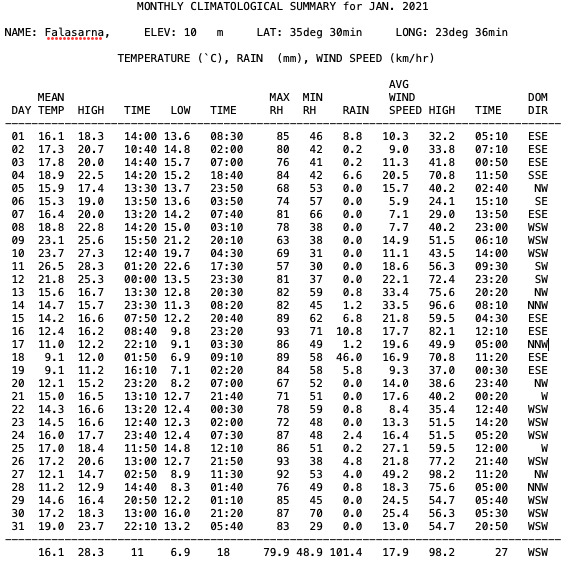
Monemvasia records 133 tropical nights per year which is unique for a location in mainland Europe. On the night of the 11th of January 2021 the World Meteorological Organization station in Falasarna recorded a stunning temperature of 28.3 °C due to strong foehn winds while the minimum temperature for that day was 22.6 °C marking both the highest January temperature during a night and the highest January minimum temperature ever recorded in Greece.
During July 2024 minimum temperatures remained over 30 °C (86 °F) for 12 consecutive days in metropolitan Athens, breaking all known records for any area in the country.
United Kingdom
The Met Office began tracking 'tropical nights' in 2018 due to their increasing frequency under climate breakdown. This criterion used to be infrequently met, with the 30 years between 1961 and 1990 seeing 44 tropical nights, most of them associated with the hot summers of 1976 and 1983. From 1991 to 11 August 2020, 84 such nights were recorded, with 21 of them occurring since 2008.
Five nights that stayed above 20 °C were recorded in 2018, and four in 2019. By 11 August 2020, four tropical nights had been recorded for that year, one in June and three in August.
During the July 2022 heatwave, a tropical night recorded overnight from 18–19 July was reported to have been the warmest on record, where temperatures in many parts of the country did not fall below 25 °C. The hottest night on record was set in the early hours of 19 July 2022 at Shirburn Model Farm, Oxfordshire, not falling below 26.8 °C, smashing the previous record of 23.9 °C in the country. This was confirmed on 23 August 2022.
During the May 2026 heatwave, an overnight temperature of was recorded in Camborne in Cornwall between 25 and 26 May, making it the warmest May night on record.
See also
Dog days Heat dome Heat wave Urban heat island
Text derived from https://en.wikipedia.org/w/index.php?oldid=1373516065 under CC BY-SA 4.0; modifications have been made.