Xerxes I
fifth Achaemenid emperor (486–465 BC)
≈ 12 min read
Names in other languages
- euXerxes I.a Persiakoa
- PolskiKserkses I
- EnglishXerxes I
- 中文薛西斯一世
- 简体中文薛西斯一世
- 繁體中文薛西斯一世
- 中文薛西斯一世
- 中文薛西斯一世
- 中文薛西斯一世
Article bodies are English and are not machine-translated. A name in another language is not a translation of the article.
Xerxes I ( ; from Old Iranian Xšayār̥šā, commonly known as Xerxes the Great; 465 BC) was a Persian ruler who reigned as the fourth King of Kings of the Achaemenid Empire, reigning from 486 BC until his assassination in 465 BC. He was the son of Darius the Great and Atossa. In Western history, Xerxes is best known for his invasion of Greece in 480 BC, which ended in Persian defeat.
Xerxes was made successor by Darius over his elder brother Artobarzan and inherited a large, multi-ethnic empire upon his father's death. He consolidated power by crushing revolts in Egypt and Babylon, and renewed his father's campaign to subjugate Greece and punish Athens and its allies for their interference in the Ionian Revolt.
In 480 BC, Xerxes led a large army and crossed the Hellespont into Europe. He achieved victories at Thermopylae and Artemisium before capturing and razing Athens. His forces gained control of mainland Greece north of the Isthmus of Corinth until their defeat at the Battle of Salamis.
Fearing that the Greeks might trap him in Europe, Xerxes retreated with the greater part of his army back to Asia, leaving behind Mardonius to continue his campaign. Mardonius was defeated at Plataea the following year, ending the Persian invasion. After returning to Persia, Xerxes dedicated himself to large construction projects, many of which had been left unfinished by his father.…
Xerxes I ( ; from Old Iranian Xšayār̥šā, commonly known as Xerxes the Great; 465 BC) was a Persian ruler who reigned as the fourth King of Kings of the Achaemenid Empire, reigning from 486 BC until his assassination in 465 BC. He was the son of Darius the Great and Atossa. In Western history, Xerxes is best known for his invasion of Greece in 480 BC, which ended in Persian defeat.
Xerxes was made successor by Darius over his elder brother Artobarzan and inherited a large, multi-ethnic empire upon his father's death. He consolidated power by crushing revolts in Egypt and Babylon, and renewed his father's campaign to subjugate Greece and punish Athens and its allies for their interference in the Ionian Revolt.
In 480 BC, Xerxes led a large army and crossed the Hellespont into Europe. He achieved victories at Thermopylae and Artemisium before capturing and razing Athens. His forces gained control of mainland Greece north of the Isthmus of Corinth until their defeat at the Battle of Salamis.
Fearing that the Greeks might trap him in Europe, Xerxes retreated with the greater part of his army back to Asia, leaving behind Mardonius to continue his campaign. Mardonius was defeated at Plataea the following year, ending the Persian invasion. After returning to Persia, Xerxes dedicated himself to large construction projects, many of which had been left unfinished by his father.
He oversaw the completion of the Gate of All Nations, the Apadana and the Tachara at Persepolis, and continued the construction of the Palace of Darius at Susa. He also maintained the Royal Road built by his father. In 465 BC, Xerxes and his heir Darius were assassinated by Artabanus, the commander of the royal bodyguard.
He was succeeded by his third son, who took the throne as Artaxerxes I.
Accession to the throne
While Darius was preparing for another war against Greece, a revolt began in Egypt in 486 BC over taxation and the deportation of craftsmen to build the royal palaces at Susa and Persepolis. The king was required by Persian law to choose a successor before setting out on dangerous expeditions; when Darius decided to leave for Egypt (487–486 BC), he prepared his tomb at Naqsh-e Rustam (five kilometers from his royal palace at Persepolis) and appointed Xerxes, his eldest son by Atossa, as his successor.
Darius could not lead the campaign due to his failing health; he died in October 486 BC at the age of 64. Artobazan claimed that he should take the crown as the eldest of all Darius's children, while Xerxes argued for his own claim on the grounds that he was the son of Atossa, the daughter of Cyrus, and that Cyrus had won the Persians their freedom.
Xerxes's claim was supported by a Spartan king in exile who was present in Persia at the time, the Eurypontid king Demaratus, who also argued that the eldest son did not universally have the best claim to the crown, citing Spartan law, which stated that the first son born while the father is king was the heir to the kingship. Some modern scholars also view the unusual decision of Darius to give the throne to Xerxes as a result of his consideration of the particular prestige that Cyrus the Great and his daughter Atossa enjoyed.
Artobazan was born to "Darius the subject", while Xerxes was the eldest son "born in the purple" after Darius's rise to the throne. While Artobazan's mother was a commoner, Xerxes's mother was the daughter of the founder of the Achaemenid Empire. Xerxes was crowned and succeeded his father in October–December 486 BC when he was about 32 years old.
The transition of power to Xerxes was smooth, due again in part to the great authority of Atossa and his accession to royal power was not challenged by anyone at court or in the Achaemenian family or by a subject nation.
Invasion of the Greek mainland
Darius died while in the process of preparing a second army to invade the Greek mainland, leaving to his son the task of punishing the Athenians, Naxians, and Eretrians for their interference in the Ionian Revolt, the burning of Sardis, and their victory over the Persians at Marathon. Xerxes initially wanted to avoid a major war with Greece, but was convinced otherwise by his father's generals headed by his cousin Mardonius, who accused him of timidity.
From 483 BC, Xerxes prepared his expedition: The Xerxes Canal was dug through the isthmus of the peninsula of Mount Athos, provisions were stored in the stations on the road through Thrace, and two pontoon bridges later known as Xerxes's Pontoon Bridges were built across the Hellespont. Soldiers of many nationalities served in the armies of Xerxes from all over his multi-ethnic massive sized empire and beyond, including the Armenians, Medes, Sakas, Elamites, Assyrians, Phoenicians, Babylonians, Egyptians, Thracians, Paeonians, Achaean Greeks, Ionian Greeks, Aegean Greeks, Aeolian Greeks, Greeks from Pontus, Colchians, Sindhis and many more.
According to the Greek historian Herodotus, Xerxes's first attempt to bridge the Hellespont ended in failure when a storm destroyed the flax and papyrus cables of the bridges. In retaliation, Xerxes ordered the Hellespont (the strait itself) whipped three hundred times, and had fetters thrown into the water. Xerxes's second attempt to bridge the Hellespont was successful.
The Carthaginian invasion of Sicily deprived Greece of the support of the powerful monarchs of Syracuse and Agrigentum; ancient sources assume Xerxes was responsible, modern scholarship is skeptical. Many smaller Greek states, moreover, took the side of the Persians, especially Thessaly, Thebes and Argos. Xerxes was victorious during the initial battles.
Xerxes set out in the spring of 480 BC from Sardis with a fleet and army which Herodotus estimated was roughly one million strong along with 10,000 elite warriors named the Immortals. More recent estimates place the Persian force at around 60,000 combatants.
Battle of Thermopylae and destruction of Athens
. Impression from a cylinder seal, sculpted c. 500–475 BC, at the time of Xerxes I Metropolitan Museum of Art At the Battle of Thermopylae, a small force of Greek warriors led by King Leonidas of Sparta resisted the much larger Persian forces, but were ultimately defeated.
According to Herodotus, the Persians broke the Spartan phalanx after a Greek man called Ephialtes betrayed his country by telling the Persians of another pass around the mountains. At Artemisium, large storms had destroyed ships from the Greek side and so the battle stopped prematurely as the Greeks received news of the defeat at Thermopylae and retreated. , destroyed by the armies of Xerxes I during the Destruction of Athens in 480 BC After Thermopylae, Athens was captured.
Most of the Athenians had abandoned the city and fled to the island of Salamis before Xerxes arrived. A small group attempted to defend the Athenian Acropolis, but they were defeated. Xerxes ordered the Destruction of Athens and burnt the city, leaving an archaeologically attested destruction layer, known as the Perserschutt.
The Persians thus gained control of all of mainland Greece to the north of the Isthmus of Corinth.
Battles of Salamis and Plataea
Xerxes was induced, by the message of Themistocles (against the advice of Artemisia of Halicarnassus), to attack the Greek fleet under unfavourable conditions, rather than sending a part of his ships to the Peloponnesus and awaiting the dissolution of the Greek armies. The Battle of Salamis (September, 480 BC) was won by the Greek fleet, after which Xerxes set up a winter camp in Thessaly.
According to Herodotus, fearing that the Greeks might attack the bridges across the Hellespont and trap his army in Europe, Xerxes decided to retreat back to Asia, taking the greater part of the army with him. Another cause of the retreat might have been that the continued unrest in Babylon, a key province of the empire, required the king's personal attention.
He left behind a contingent in Greece to finish the campaign under Mardonius, who according to Herodotus had suggested the retreat in the first place. This force was defeated the following year at Plataea by the combined forces of the Greek city states, ending the Persian offensive on Greece for good.
Construction projects
north of Persepolis, copying that of Darius, is usually assumed to be that of Xerxes. After his military blunders in Greece, Xerxes returned to Persia and oversaw the completion of the many construction projects left unfinished by his father at Susa and Persepolis.
He oversaw the building of the Gate of All Nations and the Hall of a Hundred Columns at Persepolis, which are the largest and most imposing structures of the palace. He oversaw the completion of the Apadana, the Tachara (Palace of Darius) and the Treasury, all started by Darius, as well as having his own palace built which was twice the size of his father's. His taste in architecture was similar to that of Darius, though on an even more gigantic scale.
He had colorful enameled brick laid on the exterior face of the Apadana. He also maintained the Royal Road built by his father and completed the Susa Gate and built a palace in Susa.
Death and succession
In August 465 BC, likely between 4 and 8 August, Artabanus, the commander of the royal bodyguard and the most powerful official in the Persian court, assassinated Xerxes with the help of a eunuch, Aspamitres. Although the Hyrcanian Artabanus bore the same name as the famed uncle of Xerxes, his rise to prominence was due to his popularity in religious quarters of the court and harem intrigues.
He put his seven sons in key positions and had a plan to dethrone the Achaemenids. Greek historians give differing accounts of events. According to Ctesias (in Persica 20), Artabanus then accused the Crown Prince Darius, Xerxes's eldest son, of the murder and persuaded another of Xerxes's sons, Artaxerxes, to avenge the patricide by killing Darius.
But according to Aristotle (in Politics 5.1311b), Artabanus killed Darius first and then killed Xerxes. After Artaxerxes discovered the murder, he killed Artabanus and his sons. Participating in these intrigues was the general Megabyzus, whose decision to switch sides probably saved the Achaemenids from losing their control of the Persian throne.
Religion
While there is no general consensus in scholarship as to whether Xerxes and his predecessors had been influenced by Zoroastrianism, it is well established that Xerxes was a firm believer in Ahura Mazda, whom he saw as the supreme deity. However, Ahura Mazda was also worshipped by adherents of the (Indo-)Iranian religious tradition.
On his treatment of other religions, Xerxes followed the same policy as his predecessors: he appealed to local religious scholars, made sacrifices to local deities, and destroyed temples in cities and countries that caused disorder.
Wives and children
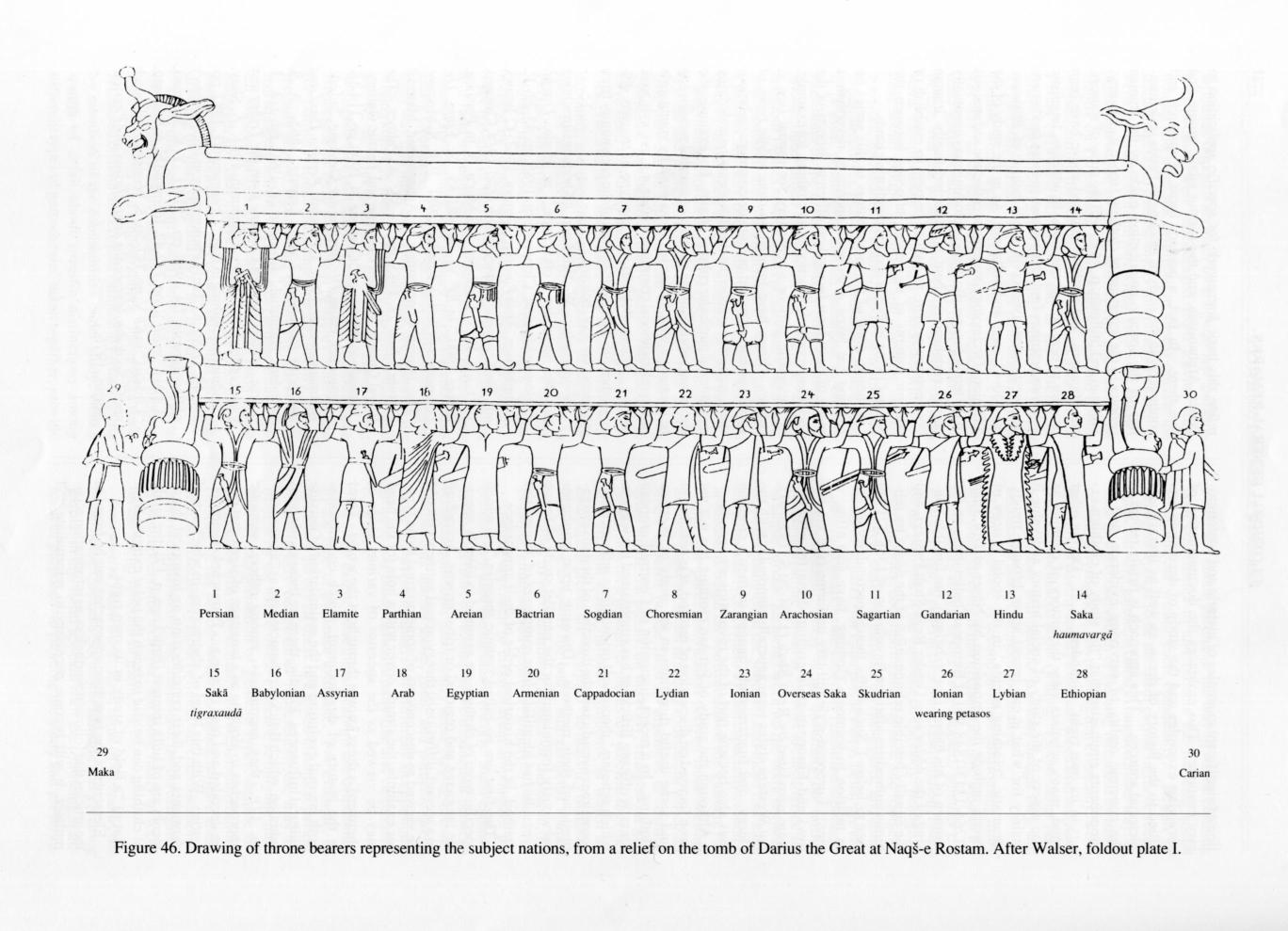
. The ethnicities of the Empire are shown supporting the throne. Ahuramazda crowns the scene. By queen Amestris: Darius, the firstborn son, murdered by Artaxerxes I or Artabanus Hystaspes, murdered by Artaxerxes I Artaxerxes I Rhodogune Amytis, wife of Megabyzus By unknown wives or mistresses: Artarius, satrap of Babylon Tithraustes Parysatis Ratashah
See also
List of biblical figures identified in extra-biblical sources
Modern sources
Bridges, Emma (2014). Imagining Xerxes: Ancient Perspectives on a Persian King. Bloomsbury.
Text derived from https://en.wikipedia.org/w/index.php?oldid=1378861972 under CC BY-SA 4.0; modifications have been made.